
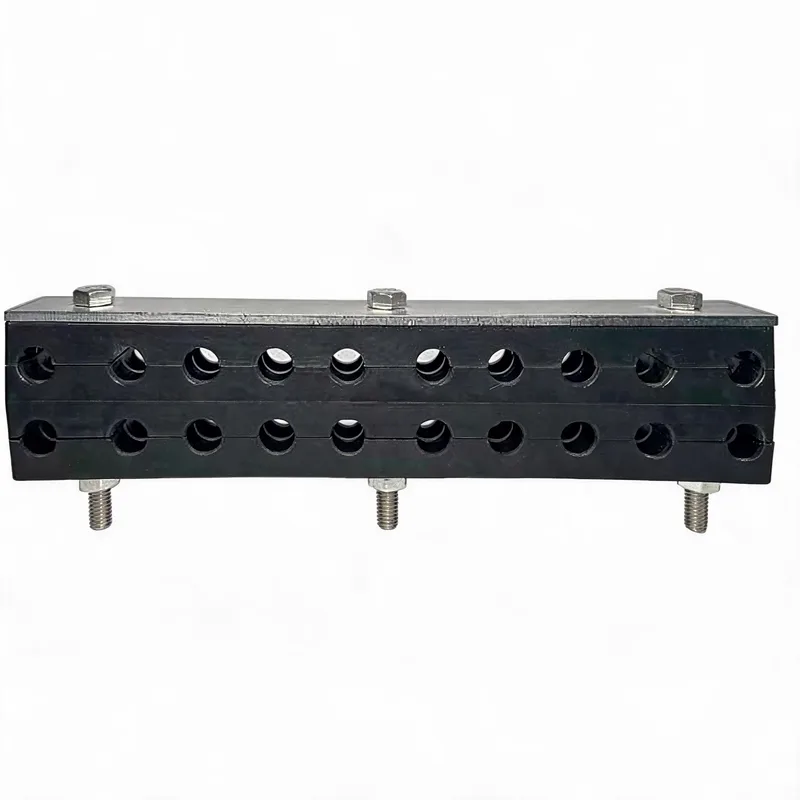
The honest specification answer, stated up front: a standard DIN 3015 pipe clamp — two polymer body halves, a cover plate and a bolt — is the right component for the utility lines in a food or pharmaceutical plant, and the wrong component for a hygienic product-contact zone. The reason is geometric, not chemical: the joint between the body halves, the bolt recess and the gap between clamp and pipe are crevices that hold water and cleaning solution after a washdown, and a crevice that stays wet is where microbial growth and stainless-steel pitting both start. In hygienic zones the support has to be crevice-minimised and fully drainable, which usually means a purpose-designed sanitary support or a smooth 316L clamp reviewed against the plant hygiene standard — not the standard catalogue clamp.
That distinction is worth making clearly because a food or pharmaceutical plant contains far more utility pipework than product pipework. Compressed air, hydraulic and pneumatic lines on packaging machinery, CIP chemical supply and return, chilled water, steam for sterilisation, vacuum, and instrument tubing all need clamping, and most of it sits in washdown or splash zones rather than in product contact. Getting the zone split right — which lines get a standard clamp, which get 316L hardware, which need a sanitary support and which need documented food-contact material compliance — is the difference between an efficient clamp schedule and either a hygiene finding at audit or a heavily over-specified order.
A standard DIN 3015 clamp has crevices — the body-half joint, bolt recess and clamp-to-pipe gap — that retain water and cleaning solution, so it belongs on utility lines in technical and washdown areas, not in a hygienic product-contact zone, where a crevice-minimised sanitary support is required. In washdown and splash zones use 316L clamps and A4 hardware; zinc-plated bolts rust out.
Mounting methods at a glance

Key points
- The problem with a standard clamp in a hygienic zone is the crevice, not the material: the body-half joint, the bolt recess and the clamp-to-pipe gap retain water and cleaning solution after washdown, and a crevice that stays wet supports both microbial attachment and chloride pitting.
- Research on bacterial attachment to stainless steel and food-processing equipment surfaces consistently shows that surface condition and retention sites, not the alloy alone, govern how readily biofilm establishes — which is why hygienic design guidance targets geometry and drainability rather than simply specifying stainless.
- Chlorinated sanitisers are the corrosion hazard people underestimate: hypochlorite-based cleaners raise the local chloride concentration, and 316L is susceptible to chloride pitting — so residue left standing in a crevice is worse for the hardware than the wash itself. Rinsability matters as much as material grade.
- Food-contact material compliance usually does not apply to a pipe clamp, because the clamp holds the outside of the pipe and never touches the product. Ask for it only where incidental contact is credible — a clamp directly above open product, for example — and then ask for the specific declaration, not a vague claim.
- The commercial upside of getting the zones right: most clamps in a food plant are on utility lines in technical areas, where a standard PP or PA clamp is entirely appropriate. Specifying sanitary supports plant-wide costs far more and buys nothing outside the hygienic zones.
Clamp choice by hygiene zone
| Zone | Typical lines | Clamp choice | Why |
|---|---|---|---|
| Product-contact / aseptic | Product transfer, aseptic filling | ★☆☆☆ Not a standard clamp — sanitary support | Crevice-free and fully drainable design required |
| Splash zone (near open product) | Utility lines above/beside product | ★★★☆ 316L, smooth, minimal crevice | Must not shed rust or harbour residue above product |
| Washdown / non-product | CIP supply, chilled water, air | ★★★★ 316L clamp or PA body + 316L bolts | Daily chemical wash; zinc-plated bolts rust out |
| Technical / service area | Hydraulics, pneumatics, plant room | ★★★★ Standard PP/PA clamp is appropriate | No product exposure; select on load and fluid |
Zone boundaries are set by the plant hygiene design, not by the clamp supplier. Hygienic machinery design is addressed by EN 1672-2 and ISO 14159, with EHEDG guidelines and the 3-A Sanitary Standards widely used as the practical design references; ask the plant or OEM which framework governs each area before selecting supports.
Why the crevice, not the material, disqualifies a standard clamp
Hygienic design guidance for food and pharmaceutical equipment is built around a small number of geometric principles: surfaces in and near the product area should be smooth, continuous, free of dead legs and crevices, and shaped so that water and cleaning solution drain away completely rather than pooling. EN 1672-2 and ISO 14159 set out hygiene requirements for machinery design, and the EHEDG guidelines and 3-A Sanitary Standards translate them into practical geometry rules. A standard DIN 3015 clamp fails these rules structurally, whatever it is made of. It has a butt joint between two body halves that a cleaning jet cannot reach into; it has a bolt recess and thread that hold liquid; and the interface between the clamp bore and the pipe surface is a narrow annular gap that fills during washdown and drains slowly. None of that is a defect — the clamp was designed to grip and damp a pipe in an industrial setting, and it does that well — but it is the opposite of what a hygienic zone requires. This is also why upgrading the material does not solve the problem: a 316L version of the same geometry still has the same crevices. Research on bacterial attachment and biofilm formation on stainless steel and food-processing equipment surfaces points the same way, showing that retention sites and surface condition drive how readily biofilm establishes rather than the alloy on its own. The practical consequence for a clamp schedule is that the question to ask is not "is this clamp stainless?" but "is this position inside a zone where crevices are prohibited?" — and if it is, the answer is a different class of support, not a different alloy.
Washdown chemistry: why 316L still needs to rinse clean
Outside the hygienic zone proper, the dominant hardware issue in a food or pharmaceutical plant is not microbiology but the cleaning regime itself. Daily washdown uses alkaline detergents, acid descalers and chlorinated sanitisers at elevated temperature, often with a pressure jet. Two consequences follow for clamp hardware. First, zinc-plated carbon steel bolts do not survive this: the coating is consumed quickly and red rust appears, which in a food plant is both a maintenance problem and an audit finding when it happens above or beside product. Stainless hardware — A4/316 grade — is the normal answer in any washdown area. Second, and less obvious, stainless is not immune. Hypochlorite-based sanitisers raise the local chloride concentration, and austenitic stainless including 316L is susceptible to chloride-induced pitting, particularly where a solution sits undisturbed and concentrates as it dries. That is why rinsability is a real specification property and not a detail: a clamp assembly that traps sanitiser in a bolt recess or between body halves is exposed to a far harsher local environment than the same clamp on a surface that drains and dries. In practice this argues for smooth 316L hardware, for orienting bolt heads so recesses drain rather than collect, and for confirming with the plant that the wash sequence includes a rinse step before selecting hardware on the assumption of "stainless is fine".
Food-contact compliance: what actually applies to a support
Food-contact material rules are frequently applied to pipe clamps by reflex, and usually they do not apply. In the EU, Regulation (EC) No 1935/2004 is the framework regulation for materials and articles intended to come into contact with food, with plastics covered by the implementing regulation and, in the US, food-contact polymers falling under FDA 21 CFR Part 177. All of these are about materials intended to contact food, or from which constituents may reasonably be expected to migrate into food. A pipe clamp grips the outside of a pipe and never touches the product, so in the great majority of positions it is outside that scope. The situation changes only where incidental contact is genuinely credible — a clamp directly above an open product stream, where a fragment or a drip could fall in. There the plant may legitimately require a declaration, and the right thing to do is to request the specific document (a food-contact declaration referencing the applicable regulation for that grade) rather than accept, or offer, a vague "food safe" claim. It is worth understanding why the underlying concern is real: published research on food-contact materials shows that migration from polymers is a genuine analytical challenge, with identification and quantification of migrating substances far from trivial. That is precisely why the regulations demand a documented material declaration rather than an assurance — and why a supplier that cannot produce one for a given grade should say so plainly. WeiQue supplies 316L stainless clamps and hardware for washdown areas, and will state clearly which grades a food-contact declaration is available for rather than making a blanket claim.
What to write in the RFQ for a food or pharmaceutical plant
The pattern across food and pharmaceutical enquiries in this product category is that the hygiene requirement arrives as a single blanket line — "must be food grade" or "hygienic design required" — applied to a clamp list that mostly covers utility pipework in technical areas. Working to that line literally either over-specifies the whole order or invites a compliance claim that does not survive scrutiny. The productive response is to split the list by zone, and four lines in the RFQ make that possible. State the hygiene zone for each group of clamps: product-contact, splash zone, washdown, or technical area — and name the governing framework if there is one (EN 1672-2, ISO 14159, EHEDG or 3-A), because the plant or OEM decides those boundaries, not the clamp supplier. State the cleaning regime: chemistry, temperature, pressure-jet use and whether a rinse step follows, since that drives hardware grade and how much crevice retention matters. State whether any position has credible incidental product contact, so a food-contact declaration is requested only where it is meaningful. And state the fluid and load per line as normal, because inside a technical area a food plant is an ordinary industrial selection problem. WeiQue supplies 316L stainless clamps and A4 hardware for washdown and splash areas and standard PP/PA clamps for technical areas; send the zone split with your line list and we will mark which positions can use standard clamps, which need stainless hardware, and which should not use a catalogue clamp at all.
Frequently asked questions
Can I use a standard DIN 3015 clamp in a food plant?
Yes on utility lines in technical and washdown areas — compressed air, hydraulics, CIP supply, chilled water — which is where most clamps in a food plant actually are. No in a hygienic product-contact zone: the body-half joint, bolt recess and clamp-to-pipe gap are crevices that retain water and cleaning solution, and hygienic design rules require crevice-minimised, fully drainable supports there.
Do pipe clamps need food-contact material certification?
Usually not. A clamp grips the outside of the pipe and never touches the product, so it falls outside the scope of Regulation (EC) No 1935/2004 and FDA 21 CFR Part 177, which cover materials intended to contact food. Request a declaration only where incidental contact is credible — a clamp directly above an open product stream — and then ask for the specific document for that grade rather than accept a vague "food safe" claim.
Is 316L enough for a daily chemical washdown?
It is the right grade, but grade alone is not the whole answer. Hypochlorite-based sanitisers raise the local chloride concentration and 316L is susceptible to chloride pitting, so sanitiser left standing in a bolt recess or between body halves is a harsher environment than the wash itself. Specify smooth hardware that rinses and drains, and confirm the wash sequence includes a rinse step.
Related WeiQue series


Recommended reading
References
Further reading: hygienic machinery design is addressed by EN 1672-2 and ISO 14159, with EHEDG guidelines and the 3-A Sanitary Standards as the practical design references; food-contact materials fall under Regulation (EC) No 1935/2004 in the EU and FDA 21 CFR Part 177 in the US. Open-access research below covers bacterial attachment to stainless steel and food-processing surfaces, biofilm on processing equipment, and migration analysis for food-contact materials.
- Bacterial Attachment and Biofilm Formation on Antimicrobial Sealants and Stainless Steel Surfaces — Foods 11(19):3096 (MDPI, open access)
- Isolation of Biofilm-Forming Bacteria from Food Processing Equipment Surfaces and the Biofilm-Degrading Activity of Bacillus licheniformis YJE5 — Foods 14(21):3592 (MDPI, open access)
- Food Contact Materials: Migration and Analysis. Challenges and Limitations on Identification and Quantification — Molecules 26(11):3232 (MDPI, open access)