
The specification rules for cold-climate pipe clamps fit in three lines: standard polypropylene homopolymer bodies are reliable to about −20 °C and embrittle below it — specify impact-modified PP copolymer for −30 °C or polyamide for −30 to −40 °C; standard NBR cushion inserts stiffen and lose their damping function below about −30 °C — specify low-temperature NBR or HNBR grades for colder sites; and do not torque polymer-bodied clamps below about −10 °C — schedule installation for warmer hours or pre-warm the components, because most cold-climate clamp cracking happens during installation, not in service.
This guide covers the ordinary cold that most northern-hemisphere industrial sites actually see — Scandinavian and Canadian outdoor plants, Russian and Kazakh oil and gas fields, mobile equipment wintering outdoors — in the −20 to −40 °C band. It deliberately stops short of cryogenic service: clamping LNG or liquid-nitrogen lines at −162 °C and below is a different engineering problem with its own insulation and cold-shoe requirements, covered in our separate cryogenic pipework guide.
Standard PP clamp bodies are reliable to about −20 °C; specify PP impact copolymer for −30 °C or polyamide for −30 to −40 °C. Standard NBR inserts stop damping below −30 °C — specify low-temperature NBR/HNBR. Do not torque polymer clamps below −10 °C.
Mounting methods at a glance
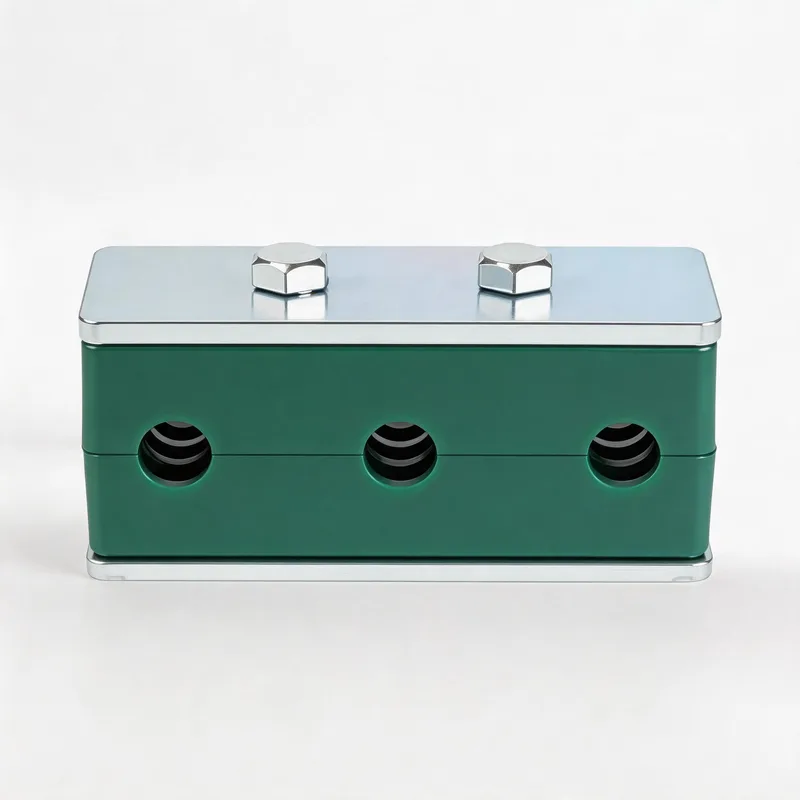
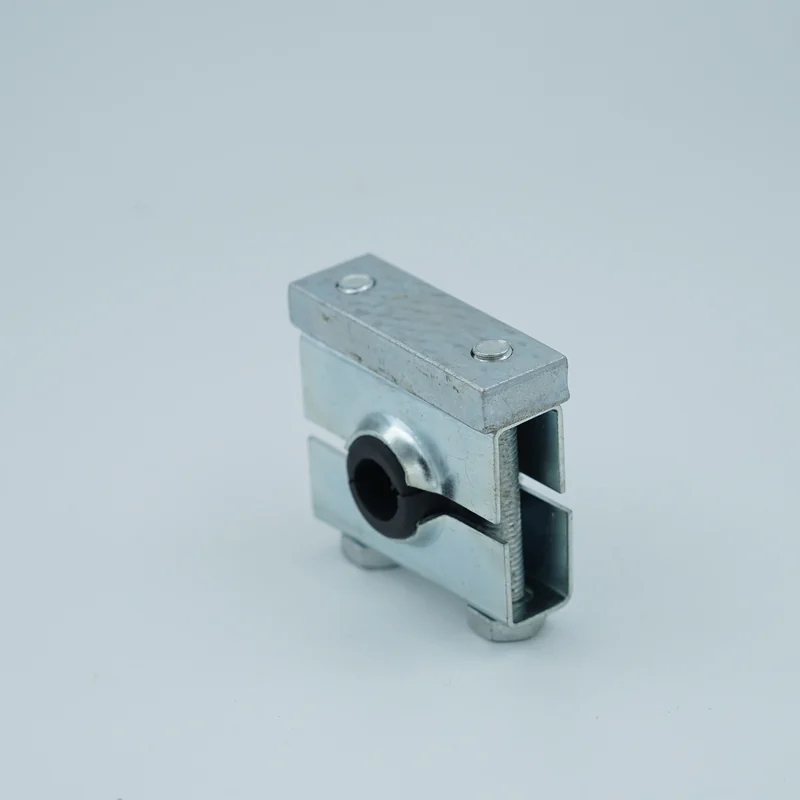
Key points
- Polymer embrittlement is a threshold behaviour, not gradual decline: below the ductile-brittle transition the failure mode switches from bending to fracture, and a clamp that survived −18 °C for years can crack the first −28 °C morning it is knocked by a tool or a pipe surge.
- Rubber-toughened PP copolymers work because dispersed elastomer particles arrest craze growth — published morphology research shows the low-temperature impact gain depends directly on rubber-phase particle size and spacing, which is why "PP copolymer" without a datasheet is not yet a specification.
- Cold hydraulic oil multiplies clamp loads: at −30 °C startup, oil viscosity can be 50–100 times the operating value, producing pressure spikes and pipe jerks that hit the clamps exactly when the polymer is at its most brittle. Cold-start vibration is a clamp-sizing load case, not a nuisance.
- An NBR insert below its glass transition still grips the pipe but stops damping — on a compressor line at −35 °C, a standard NBR cushioned clamp behaves like a rigid clamp, and the vibration problem it was bought to solve comes back silently.
- Most cold-climate clamp failures happen at installation: torquing a polymer body at −25 °C concentrates stress on a material already below its ductile range. Install above −10 °C where possible, store clamps warm until fitting, and never use impact wrenches on cold polymer bodies.
Clamp materials by minimum service temperature
| Material option | Reliable minimum | Behaviour at −40 °C | Notes |
|---|---|---|---|
| PP homopolymer body (standard) | −20 °C | Brittle — cracks under impact or over-torque | Adequate for most of Central Europe; not for northern outdoor sites |
| PP impact copolymer body | −30 °C | Marginal — verify grade datasheet | Rubber-phase morphology extends ductility; confirm Charpy value at site minimum |
| PA6 / PA66 body | −30 °C (−40 °C impact-modified) | Serviceable; dry-as-moulded parts are more brittle than conditioned | Standard choice for nacelles, northern plants and mobile equipment |
| PA11 / PA12 body | −40 °C | Retains impact toughness | Flexible chain structure; premium option where −40 °C is routine |
| Standard NBR insert | −30 °C | Glassy — damping function lost | Grip is retained but vibration isolation is not |
| Low-temp NBR / HNBR insert | −40 °C | Damping retained | Specify explicitly — will not be supplied by default |
| Steel clamp + elastomer insert | Body: no limit | Body unaffected; insert grade governs | Conservative route; check coating brittleness and galvanic pairs |
Temperatures are guideline values for unfilled or lightly filled grades under static clamp load; verify the notched impact value on the specific grade datasheet at the actual site minimum, and remember that wind chill does not lower material temperature — but nighttime radiant cooling below air temperature does.
Why polymers embrittle: the ductile-brittle transition
Every polymer has a temperature band below which the molecular chain segments no longer have enough thermal energy to move and absorb impact energy by yielding. Above the band, an overload bends or whitens the part; below it, the same overload fractures it. For polypropylene homopolymer the glass transition of the amorphous phase sits around 0 to −10 °C, and practical impact resistance is already sharply reduced by −20 °C — which is why −20 °C is the honest service limit for standard PP clamp bodies, not the −30 °C sometimes quoted from short-term flexural data. Impact copolymers push this limit down by dispersing fine elastomer particles through the PP matrix: the rubber phase cavitates under impact, blunting and arresting the crazes that would otherwise grow into cracks. Published morphology-based modelling of rubber-toughened PP shows the improvement is controlled by particle size and inter-particle spacing rather than rubber content alone — two grades with identical "copolymer" labels and rubber percentages can differ by 10 °C or more in their ductile-brittle transition. The procurement consequence is simple: for cold-climate service, a material family name is not a specification. Ask for the notched Charpy or Izod impact value at the actual site minimum temperature from the specific grade datasheet.
The polyamide route — and the moisture reversal
Polyamide bodies are the standard upgrade for −30 to −40 °C sites, and they carry a subtlety that reverses the intuition from hot-service articles: moisture helps. In hot service, absorbed water plasticises PA and lowers its strength and temperature limits; in cold service, that same plasticisation keeps chain segments mobile at temperatures where dry material would be glassy. A dry-as-moulded PA6 part straight from a sealed bag is measurably more brittle at −30 °C than the same part after a few weeks of outdoor moisture equilibrium. Two practical consequences follow. First, newly delivered PA clamps installed in mid-winter are at their most brittle exactly when the weather is coldest — another argument for warm storage and careful installation torque. Second, impact-modified PA6/PA66 grades, or the inherently flexible long-chain polyamides PA11 and PA12, are the correct call where −40 °C is routine rather than exceptional; published impact testing of PA11-based laminates confirms the retention of energy absorption that makes these grades the cold-climate premium choice. For buyers who prefer to remove the polymer question entirely, steel or stainless clamp bodies have no low-temperature limit in this band — but the elastomer insert then becomes the governing component, which is the subject of the next section, and standard carbon-steel zinc coatings should be checked for handling chipping in extreme cold.
Inserts, damping and winter installation practice
Elastomer inserts follow the same glass-transition physics as the bodies, with a harsher consequence: an insert that has gone glassy still holds the pipe, but its damping function — the reason a cushioned clamp was specified — is gone. Standard NBR compounds have glass transitions in the −30 °C region; below that, a cushioned clamp on a compressor or pump line transmits vibration essentially undamped, and the bolt-loosening and fatigue problems the cushioning was meant to prevent return without any visible change. Low-temperature NBR compounds (formulated with higher butadiene content) and hydrogenated NBR extend serviceable damping to around −40 °C, and research on low-temperature-resistant HNBR shows the flexibility retention is a formulation property that must be ordered explicitly — a supplier quoting "NBR insert" will deliver the standard compound unless the RFQ says otherwise. Installation practice matters as much as material choice. Cold polymer plus tightening torque is the single most common failure combination we see reported from northern sites: the fix is procedural, not material. Where possible, schedule clamp installation and re-torque work above −10 °C; store polymer clamps and inserts indoors until the hour of fitting; use hand torque wrenches, never impact drivers, on polymer bodies in the cold; and after a winter installation, re-check torque during the first sustained above-freezing period, because thermal cycling and insert stiffness changes alter the preload.
What we see in cold-region orders, and what to write in the RFQ
Cold-climate requirements in the enquiries we handle come mainly from three directions: wind-farm and mining projects in Scandinavia and Canada, oil and gas installations in Russia and Central Asia, and construction or agricultural machinery builders whose equipment winters outdoors. The recurring pattern is that the minimum temperature arrives as a city name rather than a number — "clamps for a project in Karaganda" — and the productive first step is always converting that to a design minimum at the equipment, because a nacelle at hub height, a pipe rack above a warm process unit and an excavator parked in open steppe see very different real minima from the same weather station. A pattern that repeats across the industry: mobile-equipment builders tend to standardise on PA bodies with low-temperature inserts fleet-wide after their first winter of cold-snap cracking on PP-bodied clamps, because the cost difference per clamp is trivial against a single field repair campaign — which is why northern-market machine specifications increasingly name the body material outright instead of leaving it to the supplier default. For the RFQ, write four lines. State the design minimum temperature at the equipment, and whether it is routine or a rare extreme. State the body material with an impact requirement: "PA6, notched impact ≥ X kJ/m² at −35 °C per grade datasheet" is a specification; "cold-resistant plastic" is not. State the insert grade explicitly — low-temperature NBR or HNBR with its minimum service temperature — if damping matters at your site minimum. And state whether installation will happen in winter, so delivery packaging, warm-storage instructions and any installation-temperature limits can be included with the goods. WeiQue supplies PP, PP-copolymer and PA clamp bodies, standard and low-temperature insert compounds, and steel clamp alternatives; send the four lines with your tube schedule and we will mark the items where the cold-climate upgrade actually changes the part number — on many positions it does not, and paying for −40 °C materials on an indoor line is money better spent on the outdoor ones.
Frequently asked questions
At what temperature do standard PP pipe clamps become unsafe?
Standard PP homopolymer bodies lose most of their impact resistance by −20 °C. Below that, the failure mode switches from bending to brittle fracture — the clamp can crack from a tool knock or a pressure surge. For −30 °C specify PP impact copolymer with a verified Charpy value; for −30 to −40 °C use polyamide bodies.
Can I install pipe clamps outdoors in winter at −25 °C?
Avoid it for polymer-bodied clamps: tightening torque on a body below its ductile range is the most common cold-climate failure we see. If winter installation is unavoidable, store clamps warm until fitting, use hand torque wrenches only, and re-check torque during the first sustained above-freezing period. Metal-bodied clamps can be installed at any temperature.
Do NBR cushioned clamps still damp vibration at −35 °C?
Standard NBR compounds do not — their glass transition sits around −30 °C, below which the insert is glassy: it still grips the pipe but transmits vibration essentially undamped. For damping at −35 to −40 °C, specify low-temperature NBR or HNBR insert compounds explicitly in the RFQ; they are not supplied by default.
Related WeiQue series


Recommended reading
References
Further reading: open-access research on low-temperature impact behaviour of rubber-toughened polypropylene, impact behaviour of polyamide laminates, and low-temperature-resistant hydrogenated nitrile rubber
- A Morphology-Based Model to Describe the Low-Temperature Impact Behaviour of Rubber-Toughened Polypropylene — Polymers 13(13):2218 (MDPI, open access)
- Flexural Properties and Low-Velocity Impact Behavior of Polyamide 11/Basalt Fiber Fabric Laminates — Polymers 13(7):1055 (MDPI, open access)
- Synthesis of Low Temperature Resistant Hydrogenated Nitrile Rubber Based on Esterification Reaction — Polymers 13(23):4096 (MDPI, open access)