
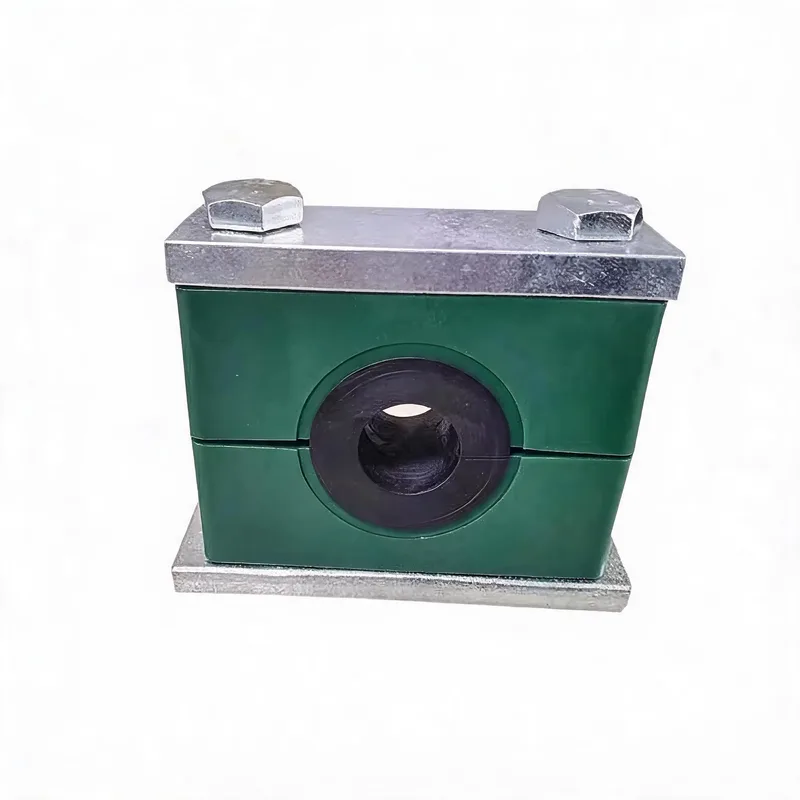
The cushion insert in a DIN 3015 pipe clamp serves three functions simultaneously: it protects the pipe surface from metal contact, damps vibration between the pipe and the structure, and provides the frictional grip that keeps the pipe from sliding axially. All three functions depend on the insert retaining its shape under the combined stress of bolt clamping force and pipe load. When service temperature rises above the material's creep threshold, the insert deforms progressively under sustained load — permanently thinning and losing both grip and damping without any outward sign of failure until the pipe moves.
PA66 is the standard insert material in most DIN 3015 pipe clamps and is correctly specified for the majority of industrial applications below 100 °C. Above this threshold, research on polyamide creep behaviour shows that sustained compressive stress accelerates permanent deformation significantly, and the problem is compounded in wet or steam-exposed conditions where moisture absorption reduces the effective glass transition temperature by 15–25 °C. Selecting the correct insert material — PA66, PA46, PEEK or metal — for the actual operating temperature is one of the most under-specified decisions in pipe clamp procurement.
PA66 pipe clamp inserts begin creeping at sustained temperatures above 100 °C (dry) or 80–95 °C (wet/steam); upgrade to PA46 for 120–150 °C service or metal inserts where vibration damping is not required.
Mounting methods at a glance
Key points
- PA66 glass transition temperature (dry) is approximately 65 °C; above this, creep rate under compressive clamp load increases significantly — sustained service above 100 °C risks permanent insert thinning and pipe slip.
- Moisture absorption is the hidden multiplier: in steam, condensate or humid outdoor service, PA66 absorbs 2.5–3.5% moisture by weight, dropping the effective service limit by up to 25 °C compared to dry laboratory ratings.
- Creep failure is silent: a clamped pipe does not show movement until the insert has deformed enough to lose grip. By the time axial slip is visible, the insert has already permanently deformed and re-torquing alone will not restore the original grip force.
- Metal inserts eliminate creep entirely but also eliminate vibration damping — on engine or compressor lines where both high temperature and vibration are present, a two-layer solution (metal insert + separate vibration isolation mount) is the correct approach.
- PA46 (Stanyl) is the cost-effective upgrade path from PA66: it maintains good creep resistance to 150 °C dry / 120 °C wet, retains vibration damping similar to PA66, and fits standard DIN 3015 clamp bodies without dimensional change.
Pipe clamp insert materials: temperature and creep comparison
| Material | Max temp (dry) | Max temp (wet/steam) | Creep resistance | Vibration damping |
|---|---|---|---|---|
| PA6 | 90 °C | 70 °C | ★★☆☆ Moderate | ★★★★ Good |
| PA12 | 100 °C | 85 °C | ★★☆☆ Moderate | ★★★☆ Good |
| PA66 (standard) | 120 °C | 95 °C | ★★★☆ Good | ★★★★ Good |
| PA46 (Stanyl) | 150 °C | 120 °C | ★★★★ Very good | ★★★☆ Good |
| PEEK | 240 °C | 240 °C | ★★★★ Excellent | ★★☆☆ Low |
| Metal (Al or SS) | No limit | No limit | ★★★★ Excellent | ★☆☆☆ None |
Wet/steam temperature limits account for moisture absorption that plasticises the polymer and reduces effective glass transition temperature. Always downrate PA materials by 15–25 °C for saturated steam or continuous condensation service.
How polymer creep degrades clamp grip: the mechanism
Creep in polymers is time-dependent plastic deformation under sustained stress — the molecular chains gradually rearrange to relieve the applied load, leaving the material permanently thinner than its original thickness even after the load is removed. In a pipe clamp insert, the applied stress is the compressive clamping force from the tightened bolt, acting through the clamp body halves onto the insert surface. At room temperature, PA66's intermolecular hydrogen bonding and semi-crystalline structure resist this rearrangement well, and the creep rate is low enough to be inconsequential over a normal service life. As temperature rises toward and above the glass transition zone (approximately 50–70 °C for PA66, depending on moisture content), chain mobility increases, hydrogen bonds weaken, and the amorphous regions of the polymer begin to flow under the sustained stress. Research on creep in polyamide structural components consistently shows that the creep rate is not a linear function of temperature: there is an accelerating nonlinearity above the glass transition zone, with a small increase in operating temperature producing a disproportionately large increase in long-term deformation. For pipe clamp service, this means that a PA66 insert at 95 °C and 115 °C are not just 20 degrees different — the 115 °C installation may see several times more insert deformation over the same service interval.
The moisture penalty: why steam and condensate service requires downrating
Polyamides are hygroscopic — they absorb moisture from the environment and from direct liquid contact, and this moisture acts as a plasticiser, inserting water molecules between polymer chains and reducing the intermolecular forces that give the material its stiffness and creep resistance. For PA66, equilibrium moisture content in humid ambient air is approximately 2.5–3.5% by weight; in direct water or steam contact it reaches saturation at 8–9%. Published research on polyamide mechanical properties in conditioned (wet) versus dry states shows that the glass transition temperature decreases by approximately 15–25 °C at equilibrium moisture content — meaning a PA66 insert rated to 120 °C dry behaves more like a 95–105 °C material in a humid outdoor installation, and more like a 70–80 °C material in continuous condensate or steam contact. The practical implication for pipe clamp specification is that the service temperature must be assessed in the wet condition for any outdoor, wash-down, steam-traced or steam-jacketed installation. A pipe clamp with PA66 inserts on a 95 °C process line in a dry indoor environment is adequately specified; the same clamp on a 95 °C steam condensate line outdoors in a humid climate is not.
PA46 vs PEEK vs metal: upgrade paths for high-temperature service
Three upgrade paths are available when PA66 inserts are not adequate for the operating temperature. PA46 (commercially known as Stanyl) is the most cost-effective upgrade for the 120–150 °C range. Its higher crystallinity and stronger hydrogen bonding give it a glass transition temperature approximately 20 °C above PA66, significantly better creep resistance at elevated temperature, and a wet service limit around 120 °C. PA46 inserts fit standard DIN 3015 clamp bodies without modification, retain useful vibration damping, and are the correct specification for most steam-traced, hot-oil and engine-bay installations in the 120–150 °C range. PEEK is the second option for service above 150 °C and up to approximately 240 °C. PEEK has negligible creep at temperatures that would cause severe flow in any polyamide; its limitation is stiffness — PEEK provides little vibration damping, and at high clamping torques can concentrate load on the pipe surface more than a softer polymer. For steam, high-temperature process and furnace area lines, PEEK is the material of choice when an all-polymer insert is required. Metal inserts — aluminium for weight-critical and lower-temperature high-vibration service, stainless for corrosive environments — eliminate creep entirely. The trade-off is that a metal insert provides no vibration damping; on lines where both high temperature and significant vibration are present (engine exhausts, compressor discharge, steam turbine extraction lines), a correctly specified vibration-isolation clamp mounting is needed in addition to the metal insert.
What to write in the RFQ for high-temperature pipe clamp inserts
A pipe clamp ordered without specifying insert material will be supplied with standard PA66 inserts. Buyers for service above 80 °C should add three items to their RFQ. First: state the operating temperature fully — continuous maximum temperature, short-duration peaks, and whether the service involves steam, condensate, or sustained outdoor humidity. "Operating temperature 130 °C, steam-traced line, outdoor installation" is the level of detail needed; "high temperature" is not. Second: state whether vibration is present. If the answer is yes, a metal insert alone is not sufficient — specify whether you need PA46 for damping retention, or a separate anti-vibration mounting. Third: request the supplier's material datasheet for the specified insert, including continuous service temperature rating (not just the material's bulk melting point), creep modulus or relaxation data at operating temperature, and confirmation of the wet-condition rating for steam or outdoor service. WeiQue supplies PA66, PA46 and metal inserts for DIN 3015 clamp bodies; specify your operating temperature and service conditions at the RFQ stage and we will confirm the correct insert and, where relevant, the re-torque requirement to compensate for initial creep settling.
Frequently asked questions
At what temperature does a PA66 pipe clamp insert start to creep permanently?
In dry service, PA66 creep rate increases significantly above its glass transition zone (approximately 65 °C), and sustained service above 100 °C risks permanent insert thinning and pipe slip. In wet, steam or condensate service, deduct 15–25 °C — a PA66 insert in continuous steam contact should not be used above 75–85 °C.
Can I replace a PA66 insert with a PA46 insert in a standard DIN 3015 clamp body?
Yes — PA46 inserts are manufactured to the same DIN 3015 bore dimensions as PA66, so they fit standard clamp body halves without modification. Confirm with your supplier that the replacement insert matches the bore size and wall thickness of the original.
How do I know if my pipe clamp inserts have crept and need replacing?
Check for three signs: bolt torque has dropped below 80% of the specified value (indicating preload loss from insert thinning); pipe can be rotated or slid axially by hand; or the clamp body halves have drawn noticeably closer together than the original gap. If any of these are present, replace the insert — re-torquing alone will not restore grip if the insert has permanently deformed.
Related WeiQue series


Recommended reading
References
Further reading: open-access research on polyamide creep behaviour under sustained compressive stress, moisture-dependent glass transition, and high-temperature polymer performance in mechanical joints
- Creep-Induced Screw Preload Loss of Carbon-Fiber Sheet Molding Compound at Elevated Temperature — Materials 12(21):3598 (MDPI, open access)
- Thermal Degradation of Glass Fibre-Reinforced Polyamide 6,6 Composites: Investigation by Accelerated Thermal Ageing — Polymers 17(4):509 (MDPI, open access)
- Effect of Temperature on the Mechanical Properties and Polymerization Kinetics of Polyamide-6 Composites — Polymers 12(5):1133 (MDPI, open access)