
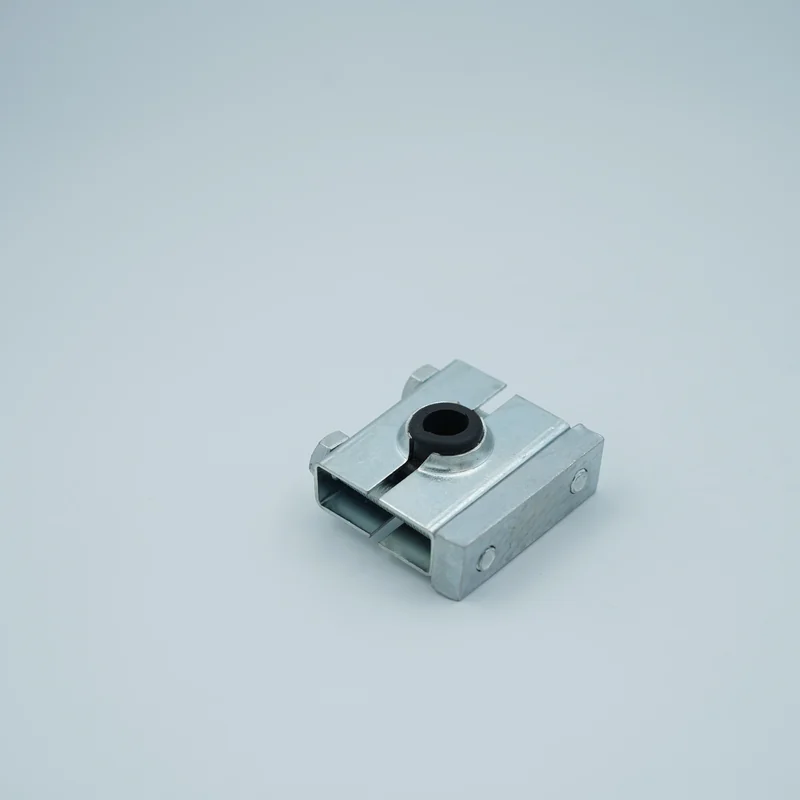
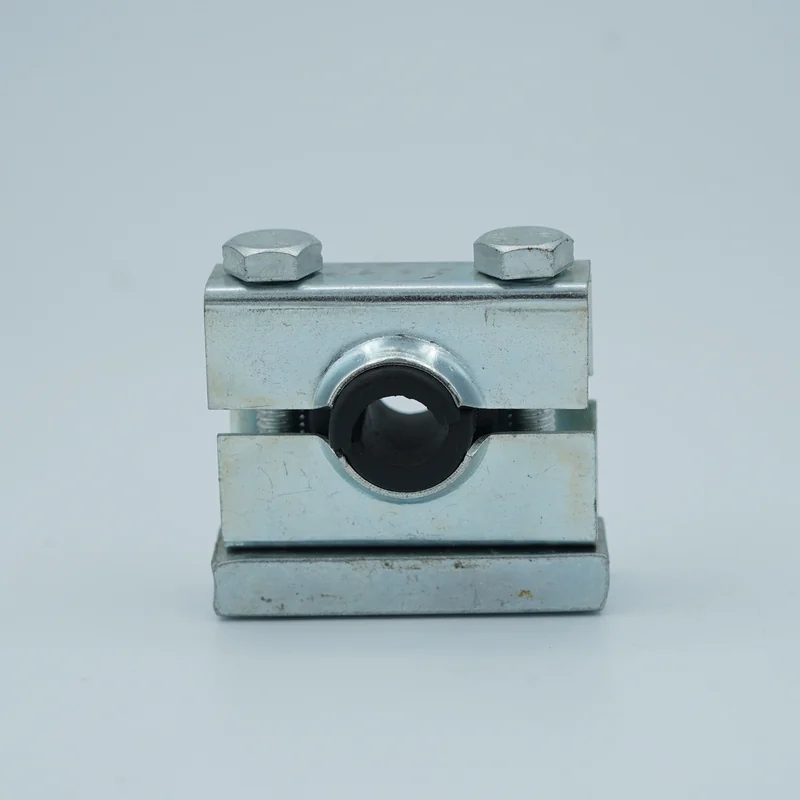
A standard DIN 3015 clamp grips the tube rigidly through its PP or PA body. A cushioned or anti-vibration version adds an NBR (nitrile rubber) insert — or a shockproof ring on twin-style assemblies — to damp vibration, reduce structure-borne noise and protect the tube surface.
Cushioned clamps are not always needed, and they are not a universal upgrade: the NBR insert has fluid and temperature limits that must be confirmed for the actual service. This guide covers when the damping is worth it and what to check before specifying it.
Cushioned clamp structure and mounting

Typical use cases
- Use cushioned/NBR clamps near pumps, motors, compressors, engines and on mobile or marine machinery where vibration or noise is significant
- Consider them for thin-wall, coated or soft tubing that a rigid body could mark
- Damping reduces fretting and helps keep bolts from loosening under vibration
- NBR has fluid and temperature limits — good for many mineral oils, review for HFC water-glycol, not for HFD phosphate ester
- A cushion does not fix a weak mounting or wrong-size bore — correct those first
Standard rigid clamp vs cushioned (NBR) clamp
| Factor | Standard rigid (PP/PA) | Cushioned / anti-vibration (NBR) |
|---|---|---|
| Vibration & noise | Transmits vibration to the structure | Damps vibration and structure-borne noise |
| Best environment | Stable indoor frames, low vibration | Pumps, engines, mobile and marine, high vibration |
| Tube protection | Firm grip, fine for standard tube | Gentler on thin-wall, coated or soft tube |
| Bolt loosening risk | Higher under vibration | Reduced by damping |
| Fluid & temperature | Broad — confirm body polymer | NBR limits — confirm fluid and temperature |
| Relative cost | Lower | Higher (insert plus compatibility review) |
Select by the real vibration source, fluid and temperature, not by default. Damping adds value only where vibration, noise or tube protection is an actual design concern.
What a cushioned clamp is
A cushioned clamp is a standard DIN 3015 assembly with an elastomer — usually NBR — between the clamp body and the tube, or a shockproof ring built into a twin-style assembly. The elastomer absorbs vibration energy, spreads contact pressure and isolates the tube from the rigid steel mounting.
When vibration damping is worth it
Damping is worth specifying when there is a real vibration source — pumps, cylinders, engines, compressors, vibrating platforms or mobile equipment — or when symptoms appear: audible structure-borne noise, polished fretting marks at the clamp, repeated bolt loosening or fatigue cracking near fittings. On a quiet, fixed indoor frame, a rigid clamp is usually sufficient.
NBR fluid and temperature limits
NBR suits many mineral hydraulic oils and general industrial environments, but it is not universal. Confirm it against the exact fluid grade and operating temperature, review it carefully for HFC water-glycol service, and do not assume it for HFD phosphate ester fluids, which can attack or soften it. Ozone, sunlight and prolonged outdoor exposure also matter. See the material guide and the HFC and HFD guides for detail.
A cushion is not a fix for bad support
Damping reduces vibration transfer, but it cannot correct a weak mounting surface, an oversized or undersized bore, or excessive support spacing. Confirm the bore matches the tube OD, the base and structure are stiff enough, and the spacing is correct first; then add damping where the application justifies it. See the mounting methods, wrong-size clamp and spacing guides.
RFQ data for a cushioned clamp
Send tube OD and wall, fluid trade name and grade, operating and peak temperature, the vibration source and severity, indoor or outdoor and washdown exposure, mounting method, required certificates and quantity. State whether the priority is noise control, tube protection or fatigue and loosening resistance.
Frequently asked questions
When do I need an anti-vibration pipe clamp?
Specify cushioned/NBR clamps near pumps, engines, compressors and on mobile or marine machinery, or when you see structure-borne noise, fretting marks, repeated bolt loosening or fatigue cracking near fittings. On quiet, fixed indoor frames a rigid clamp is usually enough.
Is an NBR cushioned clamp compatible with my hydraulic fluid?
NBR suits many mineral hydraulic oils, but confirm it against the exact fluid and temperature. Review it carefully for HFC water-glycol, and generally do not use it for HFD phosphate ester fluids, which can attack or soften it.
Does a cushioned clamp replace proper mounting and spacing?
No. Damping reduces vibration transfer but cannot fix a weak mounting surface, a wrong-size bore or excessive support spacing. Get the bore, base stiffness and spacing right first, then add damping where the application justifies it.
Related WeiQue series


Recommended reading
References
NBR (nitrile rubber) compatibility depends on the exact fluid grade, temperature and exposure. Confirm the cushion material against the fluid supplier data and project specification before release.