
The short answer: do not use a pipe clamp to restrain power cables, and do not use a cable cleat to support pipework. They look similar and both bolt a round object to a structure, but they are designed against completely different loads. A pipe clamp holds the weight of the pipe and its contents, damps vibration and accommodates thermal movement — steady, predictable loads. A cable cleat exists for one dominant load case that a pipe never sees: during a short circuit, the current in adjacent conductors produces an intense mechanical force that tries to throw them apart within milliseconds, and the cleat has to hold. That capability is not a material property you can infer from a datasheet — it is established by type testing to IEC 61914 on the specific cleat, cable size and spacing.
The confusion is understandable and, in one narrow case, the overlap is real. Small control, signal and instrument cables carrying negligible fault current are routinely supported with ordinary clamps, and that is normally fine — there is no meaningful electrodynamic force to resist. The line is crossed as soon as the cables are power conductors on a circuit with a real prospective short-circuit current: at that point the support becomes a safety component, and a product with no short-circuit test evidence is not a substitute regardless of how strong it looks.
No — they are not interchangeable. A pipe clamp is designed against pipe mass, vibration and thermal movement and has no short-circuit rating. A cable cleat is designed against the electrodynamic force of a fault and is type-tested to IEC 61914 for a specific cable size, formation and spacing. Ordinary clamps are fine on control and instrument cables with negligible fault current; power conductors need cleats with test evidence.
Mounting methods at a glance
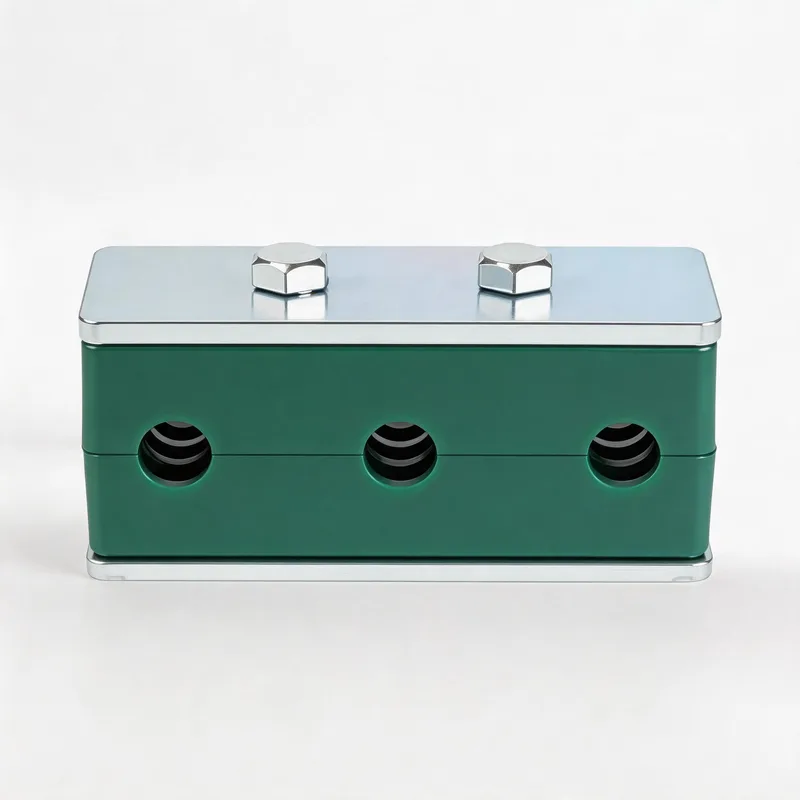
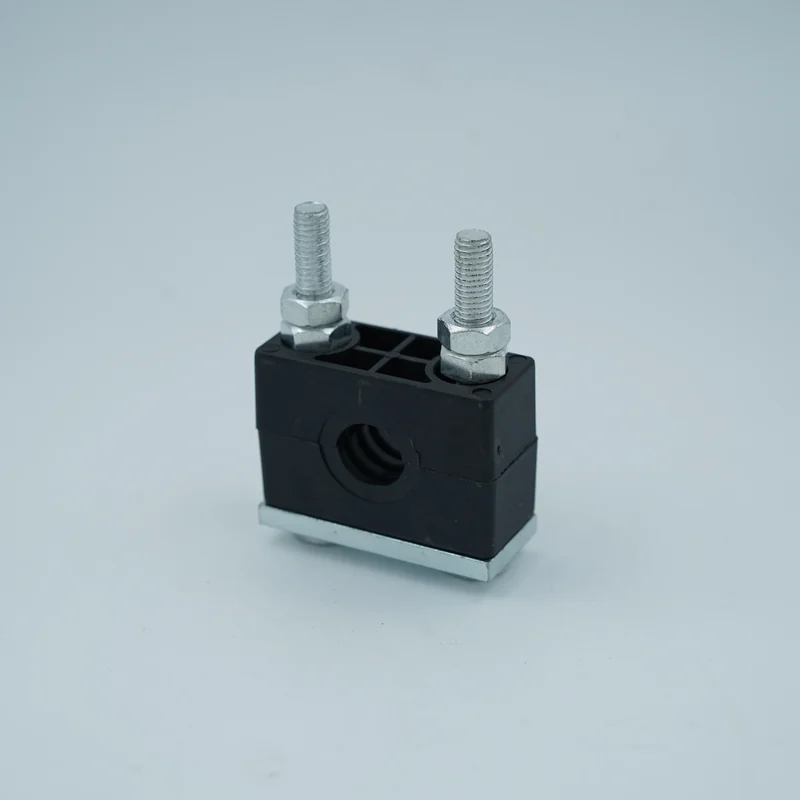
Key points
- The force between parallel conductors during a fault scales with the square of the current and inversely with the spacing — so doubling the prospective fault current roughly quadruples the force the support must hold, and closer conductors are loaded harder.
- The peak of an asymmetric fault current is higher than its RMS value, and the mechanical force follows the peak, not the average. This is why short-circuit withstand is established by test at a stated peak and duration rather than calculated from a steady-state rating.
- A pipe clamp has no short-circuit rating because nothing in its design or testing addresses that load case. It is not that it is weak — it is that no one has established what it does under a fault, and an installation cannot be signed off against an unknown.
- The substitution fails in the other direction too: a cleat has no vibration-damping insert, is shaped for a cable sheath rather than a rigid tube OD, and is not rated for the sustained mass and thermal movement of pipework. It is not a cheap pipe clamp.
- Where the two legitimately overlap: small control, signal and instrument cables on circuits with negligible prospective fault current. If you are unsure which side of the line a run falls on, the question to put to the electrical engineer is the prospective short-circuit current at that point — not the cable diameter.
Pipe clamp vs cable cleat: what each is designed against
| Aspect | Pipe clamp (DIN 3015) | Cable cleat (IEC 61914) |
|---|---|---|
| Governing load | Pipe + contents mass, vibration, thermal movement | Peak electrodynamic force during a short circuit |
| Load character | Sustained and cyclic, seconds to years | Impulsive, milliseconds, very high magnitude |
| Qualified by | Catalogue load rating, series and size | Type test at stated kA, duration and spacing |
| Vibration damping | Available via elastomer insert | Not a design function |
| Grips on | Tube OD, rigid wall | Cable outer sheath — must not crush it |
Small control, signal and instrument cables on circuits with negligible prospective fault current are commonly supported with ordinary clamps. For power conductors the support is a safety component and needs cleats with short-circuit test evidence for the actual cable, spacing and fault level.
Two different load cases, not two grades of the same product
A pipe support and a cable restraint answer different engineering questions, and that is why they are separate product categories with separate standards. The pipe clamp problem is one of sustained and cyclic loading: the support carries the weight of the tube and its contents across a span, resists the pulsation and vibration fed in by pumps and machinery, and either allows or prevents thermal movement depending on whether the point is a guide or an anchor. Everything about a DIN 3015 clamp — the bore fit to the tube outside diameter, the elastomer insert option, the load rating in the catalogue — follows from those requirements. The cable cleat problem is different in kind. Under normal operation a power cable needs very little restraint; the support exists almost entirely for the fault condition. When a short circuit occurs, the current in each conductor interacts with the magnetic field of the adjacent conductors and produces a mechanical force between them, and because that force scales with the product of the currents, a fault current many times the normal load current produces a force many times larger still. It arrives within milliseconds of fault inception, peaks with the asymmetric first cycle, and is gone before protection clears — but during those milliseconds the cables try violently to separate. The cleat has to keep them in formation without cutting into the sheath. Published analyses of electrodynamic forces in busbar and cable systems confirm the same picture: the peak mechanical loading during a fault is far beyond anything the system sees in service, and it is determined by the fault current magnitude and the conductor geometry rather than by the weight of the cable. That is why one product is rated by a catalogue load and the other by a witnessed short-circuit test.
Why the rating cannot be inferred — and what a cleat rating actually is
It is tempting to reason that a heavy-series steel pipe clamp must be stronger than a polymer cable cleat and therefore safer on cables. That reasoning fails for two reasons. First, the load is not a static pull that a strength figure can be compared against: it is an impulsive load applied to a flexible cable that will move, and what matters is whether the assembly — cleat, fixings and the structure behind it — keeps the cables in formation without the cable sheath being damaged in the process. A crushing grip that damages the insulation is a failure even if nothing breaks. Second, a short-circuit rating is a property of a tested configuration, not of a component in isolation. An IEC 61914 short-circuit test is performed on a specific cleat design holding a specific cable size in a specific formation at a specific spacing between cleats, at a declared peak current and duration; change the cable diameter or open up the spacing and the tested result no longer applies. This is why cleat suppliers publish ratings tied to a configuration, and why the cleat spacing on a drawing is part of the safety case rather than a convenience. A pipe clamp carries none of this. Nothing in DIN 3015 addresses fault current, no test has been performed, and there is no configuration to which a rating could be attached. It is not a question of margin — there is simply no evidence to evaluate. An installation that relies on such a support for power cables has an unverified assumption at a safety-relevant point, which is exactly what an inspection or an insurer will object to.
Where a pipe clamp is genuinely acceptable on cables
The honest boundary is worth stating clearly, because an absolute prohibition would be wrong and would push buyers toward ignoring the guidance entirely. Ordinary clamps are routinely and reasonably used on control, signal, instrument and small auxiliary cables where the prospective fault current at that point is negligible: there is no meaningful electrodynamic force to resist, and the support is doing what a pipe clamp does well — holding weight, keeping a run tidy and resisting vibration. Multi-hole polymer or stainless block clamps are a common and appropriate choice for parallel instrument cable runs on skids, in panels and along machine frames. What changes the picture is not the physical size of the cable but the energy available behind it. A large-section power conductor on a circuit fed from a substation carries a prospective fault current that makes the support a safety component; a thin instrument cable on a 24 V loop does not. Two practical rules follow. First, when in doubt, ask the electrical engineer for the prospective short-circuit current at that location rather than judging by cable diameter — that number, not the appearance of the cable, decides the category. Second, do not mix the categories on one drawing without labelling them: a clamp schedule that silently includes power cable positions alongside instrument runs is how an unrated support ends up on a fault-carrying circuit.
What to send so the right product is quoted
Enquiries in this category often arrive describing the object to be held — "clamps for 3 × 240 mm² cables" — without saying which load case governs, and a supplier answering literally will quote the wrong family. Four lines resolve it. State whether the run is power or control/instrument, because that alone usually decides the category. State the prospective short-circuit current and the fault duration if the run is power, since those are the values a cleat rating is declared against and no meaningful cleat proposal can be made without them. State the cable outside diameter and the formation — trefoil or flat, and the intended spacing between supports — because a short-circuit rating belongs to a tested configuration and the spacing is part of it. And state the environment as usual, since material selection for corrosion, temperature and fire runs in parallel with the mechanical question. WeiQue supplies DIN 3015 pipe clamps, multi-hole block clamps for instrument and control cable runs, and trefoil and single-core cable cleats made to cable outside diameter; tell us the fault level and formation and we will confirm which family applies, including saying plainly when a position needs certified short-circuit data that has to come from a type test rather than from a catalogue.
Frequently asked questions
Can I use pipe clamps to hold power cables?
No. A pipe clamp has no short-circuit rating because nothing in DIN 3015 or in its testing addresses fault current. During a short circuit the current in adjacent conductors produces an intense force that tries to throw them apart in milliseconds, and only a cable cleat type-tested to IEC 61914 has established evidence of holding it. On power circuits the support is a safety component.
Is it ever acceptable to clamp cables with an ordinary clamp?
Yes, for control, signal, instrument and small auxiliary cables where the prospective fault current at that point is negligible — there is no meaningful electrodynamic force to resist. Multi-hole block clamps are a common, appropriate choice for parallel instrument runs. The deciding value is the prospective short-circuit current at that location, not the cable diameter; ask the electrical engineer for it.
A steel pipe clamp is stronger than a plastic cleat — is it not safer?
Strength is not the property being qualified. The fault load is impulsive and applied to a flexible cable, and what matters is whether the assembly keeps the cables in formation without crushing the sheath — a grip that damages insulation is a failure even if nothing breaks. A short-circuit rating also belongs to a tested configuration (cleat, cable size, formation, spacing), not to a component in isolation, so there is no rating to compare a pipe clamp against.
Related WeiQue series


Recommended reading
References
Further reading: cable cleats are governed by IEC 61914, which establishes short-circuit withstand by type test on a stated cleat, cable size, formation and spacing; DIN 3015 governs pipe clamps and does not address fault current. Open-access research below covers electrodynamic forces in three-phase conductor systems and short-circuit behaviour of cable formations.
- Short-Circuit Conditions and Thermal Behaviour of Different Cable Formations — Energies 17(17):4395 (MDPI, open access)
- Calculations of Electrodynamic Forces in Three-Phase Asymmetric Busbar System with the Use of FEM — Energies 13(20):5477 (MDPI, open access)
- Electrodynamic Forces in Main Three-Phase Busbar System of Low-Voltage Switchgear — FEA Simulation — Energies 17(8):1891 (MDPI, open access)