
Vertical pipework creates a load case that horizontal spacing rules do not fully address. The support system must control lateral movement while also deciding where the downward and upward axial loads go.
DIN 3015 clamps can be part of the solution, but ordinary clamping friction should not be treated as a guaranteed riser support unless the complete assembly has been designed or validated for that load.
Yes, DIN 3015 clamps can locate and guide vertical pipe runs, but an ordinary clamp should not automatically be credited with carrying the full axial weight by friction. Pipe, fluid, fittings, acceleration and thermal loads need a defined axial support or fixed-point load path.
Related product photos
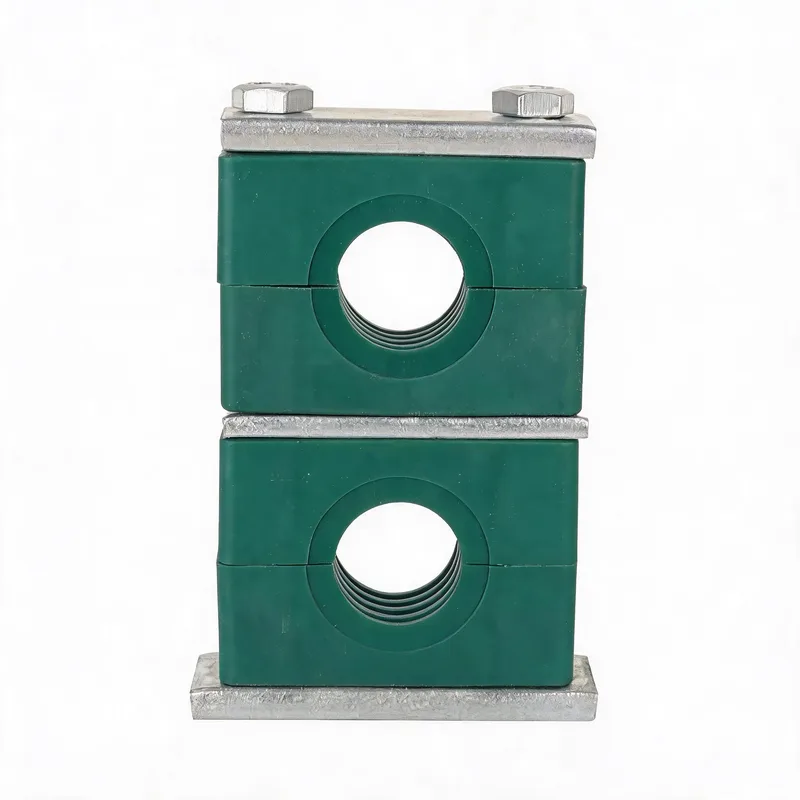
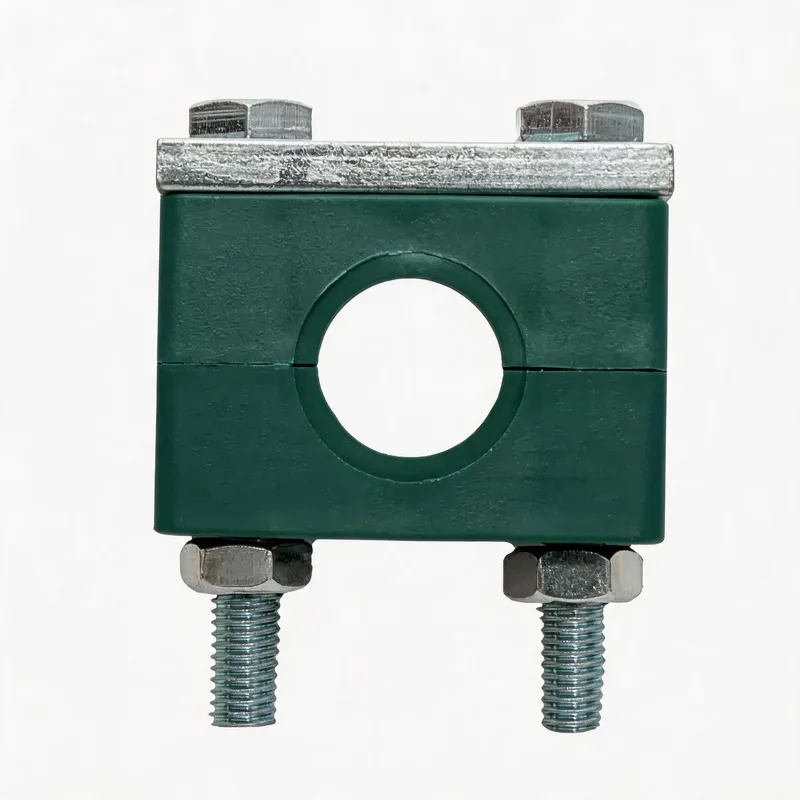
Typical use cases
- Calculate pipe, fluid, fitting and insulation mass
- Assign separate axial-support and lateral-guide functions
- Check upward loads from pressure, acceleration and thermal movement
- Verify the bracket, rail, weld and machine frame load path
Vertical support function matrix
| Function | Primary job | Must be verified |
|---|---|---|
| Lateral guide clamp | Control sway, vibration and alignment | Clearance, guide stiffness and thermal travel |
| Positive axial support | Carry pipe and fluid weight through a mechanical stop | Axial load, local pipe stress and support capacity |
| Fixed point | Establish movement reference and resist specified loads | Complete load path into bracket and structure |
| Ordinary grip clamp | Locate and damp the pipe according to its design | Do not assume axial capacity from tightening torque alone |
A clamp can guide a vertical pipe without being the component that carries its full weight.
Define the vertical load case
Include dry pipe mass, contained fluid, fittings, valves, hoses, insulation and any maintenance attachments. Also consider pressure thrust where relevant, machine acceleration, shock, pulsation, seismic or transport loads and thermal movement that may reverse or redistribute axial force.
Do not convert tightening torque directly into axial capacity
Bolt torque creates preload, but axial slip resistance also depends on body stiffness, bore fit, tube surface, material, contamination, temperature and vibration. Without validated test data or an approved calculation, friction-only support has uncertain capacity and can degrade in service.
Provide a positive support where weight is carried
Use a project-approved detail such as a fixed-point assembly, collar, shoulder, welded attachment, shelf or purpose-designed riser support. Confirm local pipe stress and ensure the base plate, rail restraint, weld, bracket and supporting frame can transmit the load without slip or unacceptable deformation.
Use guide clamps to control the route
Intermediate clamps can control lateral vibration, buckling tendency and alignment between axial supports. Their spacing depends on pipe stiffness, mass, excitation, route and bracket rigidity. If thermal movement is expected, guide details must preserve the intended axial travel.
RFQ data for vertical pipework
Send pipe OD, wall and material, vertical height, fluid and operating condition, fitting and valve weights, insulation, route drawing, support locations, expected vibration and thermal movement, mounting structure, available axial-load calculation, quantity and documentation requirements.
Frequently asked questions
Can clamp friction support the weight of a vertical pipe?
Do not assume so without a validated load calculation or tested assembly. Friction changes with body material, tube surface, contamination, temperature, tightening condition and vibration, so a positive axial support is usually more controllable.
What is a positive axial support?
It is a designed feature that transfers downward or upward axial load through a defined mechanical path, such as an approved fixed-point assembly, pipe collar, shoulder, welded attachment or purpose-designed support detail.
Do vertical pipe runs still need guides?
Often yes. Guides control lateral movement, vibration and alignment while the axial support carries weight. Their locations must also allow any intended thermal movement and avoid overloading fittings or equipment connections.
Related WeiQue series


Recommended reading
References
These pages summarize public standard metadata and industry application information. They do not reproduce the paid DIN standard text.