
Short answer: polymer pipe clamps (PP or PA bodies, NBR inserts) stored indoors in original cartons — dry, off the ground, out of direct sunlight — keep full mechanical properties for at least 3–5 years. The same clamps left outdoors on a project site in direct sun can show surface chalking on PP within 6–12 months, and the degraded surface layer marks the start of embrittlement. The storage condition, not the calendar age, determines whether stock is still fit for installation.
This question comes up most often with project orders: a full clamp schedule is purchased at the start of a project, and installation stretches over one to two years. Part of the stock inevitably ends up stored on site — sometimes indoors, sometimes under a tarpaulin, sometimes on an open laydown yard. Published research on polymer weathering shows the degradation drivers are specific and predictable: UV radiation attacks PP fastest, moisture changes PA dimensions and stiffness, and ozone plus UV crack NBR rubber. Each has a different storage countermeasure, and all three are cheap compared to re-purchasing rejected stock.
PP and PA pipe clamps stored indoors, dry and in original cartons keep full properties for 3–5+ years; unprotected outdoor storage can chalk PP within 6–12 months and crack NBR inserts within 3–6 months.
Mounting methods at a glance
Key points
- The three degradation drivers are independent: UV attacks PP (chalking, embrittlement), moisture changes PA (dimensional swell, stiffness loss), and ozone plus UV crack NBR. A storage plan must address whichever your stock actually faces — a sealed carton solves all three.
- Chalking on PP is a stop signal, not a cosmetic issue: the white powdery surface is photo-oxidised polymer, and research on UV-aged polypropylene links it directly to loss of impact strength. A chalked clamp body may still torque up normally and then crack in service.
- First in, first out (FIFO) matters more than buyers expect: we print the production date on every carton precisely so that site stores can rotate stock. Installing the oldest cartons first keeps the average storage age of the whole order low at no cost.
- NBR inserts are the most storage-sensitive component. Store insert cartons in the coolest, darkest corner of the container, away from electric motors (ozone sources), and inspect for surface crazing before installation if storage exceeded 12 months.
- For staged projects, staggered delivery beats long site storage: splitting one order into two or three shipments aligned with the installation schedule costs little in freight and removes the storage risk entirely for most of the stock.
Safe storage duration by condition and material
| Storage condition | PP body | PA body | NBR insert |
|---|---|---|---|
| Indoor, dry, original cartons | 5+ years | 5+ years | 3–5 years |
| Indoor, unheated / humid | 5 years | 3 years (moisture uptake) | 3 years |
| Outdoor, covered (tarpaulin) | 12–18 months | 12–18 months | 6–12 months |
| Outdoor, direct sun, no cover | 6–12 months to chalking | 12 months (surface yellowing) | 3–6 months (ozone cracks) |
Durations are conservative guidance for standard (non-UV-stabilised) grades in temperate climates; halve the outdoor figures for desert or tropical sites. UV-stabilised black grades extend outdoor tolerance substantially but are a special-order item — see the RFQ section.
What actually degrades: three materials, three mechanisms
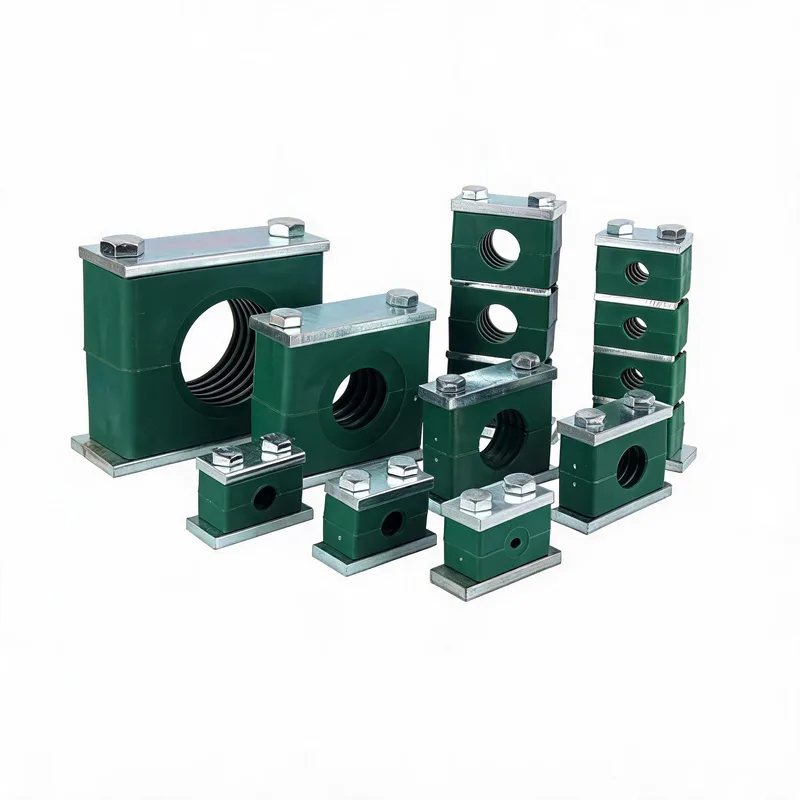
A DIN 3015 clamp assembly in storage contains three polymer systems, each with its own weak point. Polypropylene clamp bodies degrade by UV photo-oxidation: solar UV cleaves polymer chains at the surface, producing the characteristic white chalky layer, and the embrittled surface becomes the initiation site for cracks when the clamp is later torqued or shock-loaded. Research on UV-aged polypropylene consistently measures significant impact-strength loss well before the part looks visibly damaged beyond slight surface dulling — chalking is a late-stage symptom, not an early warning. Polyamide bodies resist UV better than PP but are hygroscopic: in humid unheated storage they absorb 2–3% moisture, swelling slightly and softening. Unlike UV damage, moisture uptake is largely reversible and rarely a rejection reason on its own — but a PA clamp measured for a tight bore fit immediately after months in humid storage can read fractionally oversize. NBR rubber inserts age fastest: ozone (from sunlight acting on air, or from nearby electric motors) attacks the unsaturated rubber backbone and produces fine surface cracks perpendicular to any stress, and UV accelerates the same chemistry. This is why elastomer shelf-life rules in standards such as ISO 2230 are stricter than anything applied to rigid thermoplastics.
What we see on project stock: two patterns from the factory side
Two storage failure patterns account for nearly every storage-related complaint in this product category. The first is the open laydown yard — the classic case on long pipeline and plant projects, where clamp orders shipped at project start can spend six months or more on open racks before their section reaches installation. The tell-tale signature is one-sided chalking: PP bodies facing the sun degrade visibly on the exposed side while the shaded side of the same clamps still looks new, because UV damage is strictly line-of-sight. The standard site response is to screen the stock, install the clamps from unexposed cartons and re-order replacements for the exposed rack — a replacement order costs a fraction of what a cracked-clamp incident on a commissioned line would. The second pattern is the sealed but sun-heated container. Cartons stored in a closed steel container in a hot climate see no UV at all, but repeated 60 °C+ daily cycles for a year can warp thin-wall PP covers slightly and accelerate NBR hardening. Both patterns have the same cheap fix: keep the original cartons closed (the cardboard itself is an effective UV screen), keep them off the floor on pallets, and put the container or rack in shade. For staged deliveries, ask at RFQ stage for the production or packing date to be marked on each carton or stated on the packing list — a no-cost request most manufacturers, WeiQue included, will accommodate — so site stores can apply first-in-first-out; on long projects, insist that your warehouse actually uses it.
Incoming inspection of stored stock before installation
Before installing clamps that have been stored longer than 12 months — or any duration outdoors — run a five-minute screen per batch rather than per piece. First, wipe a white cloth across several PP body surfaces: white powder transfer means chalking has started, and affected cartons should be rejected for pressure-bearing or vibrating lines (they remain acceptable for temporary or non-critical supports at your engineer's discretion). Second, check PA bodies for surface yellowing and verify one sample bore with callipers if the application has a tight OD fit. Third, flex one NBR insert from each carton through 90° and look for surface crazing at the bend; fine parallel cracks mean the batch needs replacement inserts even if the bodies are fine — inserts are cheap and available separately, so do not discard complete assemblies over insert aging alone. Fourth, check carton production dates and install oldest first. Finally, record what you rejected and why: on multi-year projects this record is what turns a vague "the clamps were stored too long" dispute into a clean warranty conversation with the supplier.
What to write in the RFQ for project orders with long site storage
If your installation schedule means clamps will sit on site for more than a few months, three RFQ lines remove most of the risk. First, packaging: "Cartons max 15 kg, clamps in PE inner bags, production date and batch printed on each carton." The PE bag adds a moisture barrier for PA and keeps dust off NBR; the printed date enables FIFO. Second, if outdoor storage is unavoidable, ask about UV-stabilised grades: carbon-black-stabilised PP and PA bodies tolerate outdoor exposure dramatically better than standard grey/beige grades. They are a special-order item with a minimum quantity and a small price premium, so this only makes sense to specify at the initial order, not as an afterthought. Third, consider staggered delivery: "Delivery in three lots aligned to installation phases, schedule to be confirmed at order." WeiQue supports split shipment on project orders at no handling surcharge, and we will match insert and body batches within each lot so that any future warranty question maps cleanly to one production batch. If you already hold stock of uncertain condition, send us photos of the surface and the carton date codes — screening advice costs nothing and is faster than re-ordering.
Frequently asked questions
How long can PP or PA pipe clamps be stored before installation?
In dry indoor storage, in original closed cartons, off the ground and out of direct sun: at least 3–5 years with no meaningful property loss for PP and PA bodies. NBR rubber inserts are more sensitive — plan on 3–5 years indoors and inspect for surface crazing beyond that. Outdoor storage shortens all of these dramatically.
Can I still use pipe clamps that were stored outdoors for a year?
Screen them before deciding. Wipe a white cloth on the PP surface: powder transfer means chalking (photo-oxidation) has started and those cartons should not go on pressure-bearing or vibrating lines. Flex one NBR insert per carton through 90° and reject batches showing fine parallel cracks. Clamps that were inside closed cartons under cover usually pass; loose or sun-exposed pieces usually do not.
What should I specify when ordering clamps for a project with staged installation?
Three lines: PE inner bags with production date and batch printed on each carton (enables FIFO and adds a moisture barrier); UV-stabilised black grades if outdoor storage is unavoidable (special-order, must be specified at initial order); and staggered delivery in lots aligned to installation phases, which removes storage risk for most of the stock at little freight cost.
Related WeiQue series


Recommended reading
References
Further reading: open-access research on UV ageing of polypropylene, outdoor weathering modeling of polymers, and physical aging of polyamides
- Characterization of Morphological, Thermal, and Mechanical Performances and UV Ageing Degradation of Post-Consumer Recycled Polypropylene for Automotive Industries — Materials 18(5):1090 (MDPI, open access)
- Mathematical Modeling of Outdoor Natural Weathering of Polycarbonate: Regional Characteristics of Degradation Behaviors — Polymers 13(5):820 (MDPI, open access)
- The Effect of Physical Aging and Degradation on the Re-Use of Polyamide 12 in Powder Bed Fusion — Polymers 14(13):2682 (MDPI, open access)