
Almost every clamp installation pairs dissimilar metals without anyone deciding it consciously: an aluminum trefoil cable cleat closed with stainless steel bolts, a 316L pipe clamp assembly sitting on a hot-dip galvanized mounting rail, an aluminum tube clamp welded bracket on a carbon-steel structure. In dry indoor service these pairings are usually harmless. In marine or coastal air — salt spray, condensation, washdown — they become galvanic couples: the less noble metal corrodes preferentially, and the joint that looked fine at delivery quietly loses section right where the load passes.
The scale of the effect is not marginal. A peer-reviewed open-access study of aluminum plates joined by stainless steel bolts measured total material loss around six times higher than in the equivalent all-aluminum joint, with the aluminum acting as the sacrificial anode. Separate exposure studies confirm that marine atmospheres drive corrosion rates far above urban sites for the same materials. None of this makes aluminum-stainless pairings forbidden — stainless bolts on aluminum cleats are an industry-standard configuration — but it does make three things mandatory in procurement: name the pairing, name the environment, and name the isolation measures. This guide turns those three into concrete RFQ lines.
Aluminum clamp or cleat bodies bolted with stainless steel are a workable standard pairing, but in marine air the aluminum corrodes preferentially — open-access testing measured several-fold higher material loss than all-aluminum joints — so the RFQ must name the exposure class, every metal pairing and the isolation parts.
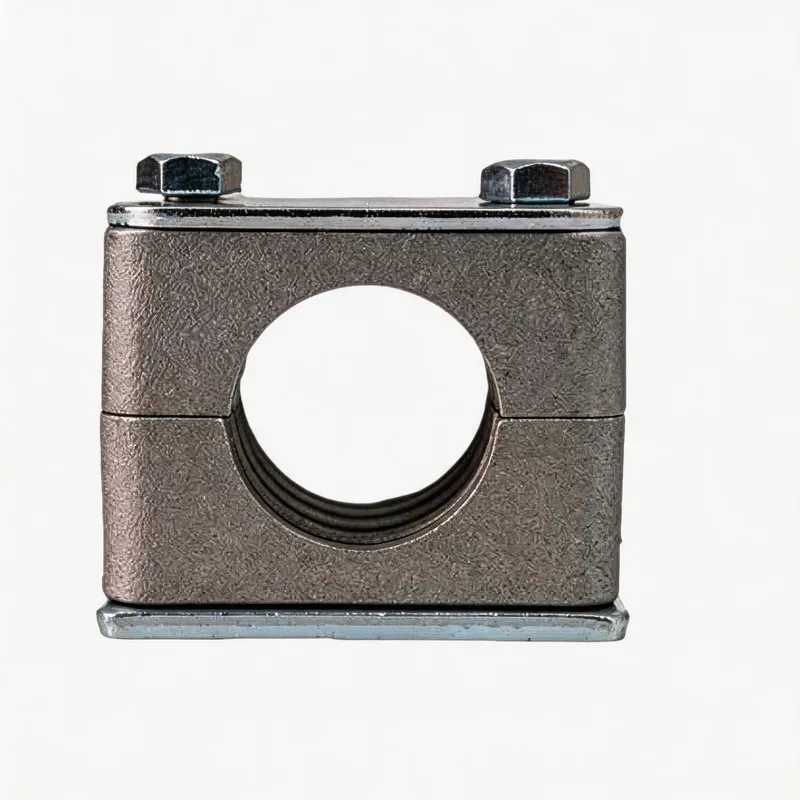
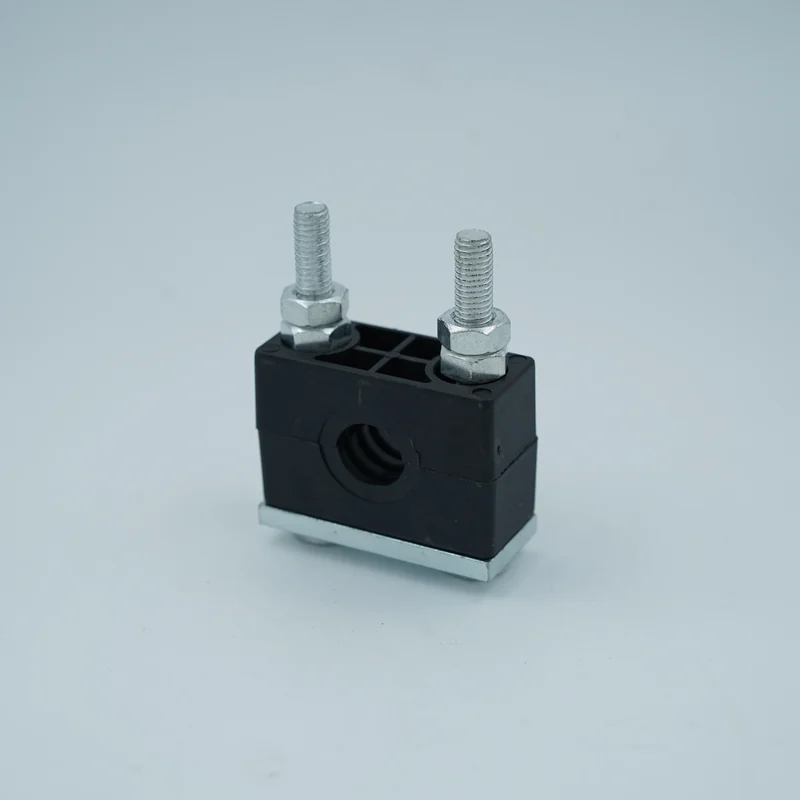
Metal pairings in practice
Key points
- Galvanic corrosion needs three things: two dissimilar metals, electrical contact and an electrolyte — marine air supplies the third
- Research on Al-SS bolted joints measured several-fold higher material loss than all-aluminum joints; the aluminum is the sacrificial side
- Favorable area ratio (small stainless bolt, large aluminum body) is why standard cleat configurations remain workable
- Isolation (washers, sleeves, pads, polymer bodies) and barrier coatings are cheap at ordering time and expensive to retrofit
- Write the pairing, the exposure class and the isolation measures into the RFQ — do not leave them to the supplier to guess
Common clamp-hardware pairings in marine air
| Pairing | Galvanic risk | What to specify |
|---|---|---|
| Aluminum cleat body + stainless bolts | Aluminum is anodic; small-bolt/large-body area ratio keeps it workable but corrosion concentrates at contact faces | Isolation washers or sleeves, anti-seize on threads, marine-grade alloy (LM6), coating evidence |
| Stainless clamp assembly + galvanized rail | Zinc is strongly anodic to stainless; the rail coating sacrifices itself around every contact point | Match rail material to clamp grade (stainless rail for 316L systems) or specify isolation pads and inspection interval |
| Aluminum clamp bracket + carbon-steel structure | Both corrode; crevice moisture at the faying surface accelerates attack on the aluminum | Barrier coating on the joint, drainage so water cannot pool, dissimilar-metal review in the project spec |
| Polymer clamp body + any metal hardware | Lowest risk — the non-conductive body breaks the galvanic path between hardware items | Confirm polymer grade suits UV and temperature; hardware grade still set by exposure (A2 vs A4/316) |
Risk always depends on the electrolyte: the same pairing that survives indoors can fail on a quayside. Classify the environment first, then the metals.
Why marine projects cannot ignore this
Wind farms, ports, ships and coastal plants combine everything galvanic corrosion needs: chloride-laden air as a persistent electrolyte, long design lives, and thousands of small bolted connections that nobody inspects individually. Exposure research consistently places marine atmospheres among the most aggressive classes for bare and coated metals alike — corrosion rates several times urban values for the same alloy. A clamp or cleat is a small part, but it sits in the load path of a pipe or a high-voltage cable; losing section at the clamp interface means losing restraint exactly where a fault force or vibration will test it. The failure mode is quiet: no leak, no alarm, just a joint that no longer holds its rated load when it matters.
What the research actually says — in buyer terms
Three distilled findings matter for procurement. First, magnitude: in accelerated corrosion testing of aluminum plates bolted with stainless steel hardware, total material loss reached roughly six times the loss of an identical all-aluminum joint — the dissimilar pairing itself, not the environment alone, multiplied the damage. Second, location: the attack concentrates at and around the contact interfaces, which is precisely where a clamp transfers load, so strength falls faster than average metal loss suggests. Third, mitigation works: studies of insulated bolted joints show that breaking the electrical path with polymer isolation dramatically reduces corrosion depth and volume. Translated to purchasing: the pairing decision and the isolation decision are as important as the material grade on the drawing.
What to write in the RFQ
Add four lines to any clamp or cleat RFQ for coastal or offshore service. (1) Environment: name the exposure class in plain words — coastal outdoor, offshore splash-free deck, washdown area — instead of only "marine". (2) Pairings: list every metal-to-metal contact in the installed system, including the mounting rail or bracket the supplier does not deliver; ask the supplier to flag incompatible pairs. (3) Isolation: state which isolation parts are required and who supplies them — washers or sleeves between stainless bolts and aluminum bodies, pads between clamp feet and dissimilar structure. (4) Evidence: request material certificates for metal parts, coating type and thickness with salt-spray test hours, and the anti-seize or lubricant specification for stainless threads. Four lines, one email — and the quotation you receive becomes comparable across suppliers on the factor that actually determines service life.
What the supplier must confirm back
A qualified supplier should answer with data, not adjectives. For aluminum parts: the actual alloy and temper (marine-grade LM6 or 6000-series, not just "aluminum") and any anodizing or coating with thickness. For stainless hardware: the grade (A2/304 vs A4/316) matched to your chloride exposure, and the anti-galling measure for threads. For coated steel parts: zinc thickness in microns or hot-dip class, with salt-spray hours from an identified test regime. For the assembly: which isolation parts are included in the scope, their material, and — often forgotten — the torque values valid with those isolation parts in place, since a washer or sleeve changes the joint stiffness. If a supplier cannot state these within one revision of the quotation, the low unit price is carrying hidden risk.
Frequently asked questions
Can I use stainless steel bolts on an aluminum cable cleat or clamp?
Yes — it is the industry-standard configuration, and the area ratio works in your favour: a small stainless cathode against a large aluminum anode keeps the galvanic current density low. In marine or washdown service, still specify isolation washers or sleeves, anti-seize on the threads, and a marine-grade alloy body, because the attack concentrates at the contact faces.
How much faster does aluminum corrode when bolted to stainless steel?
Published open-access testing of aluminum plates joined with stainless hardware measured total material loss roughly six times higher than an identical all-aluminum joint under the same corrosive exposure. The exact factor depends on electrolyte, area ratio and geometry, but the direction is consistent: the aluminum side pays.
What isolation parts should I put in the RFQ for mixed-metal clamp hardware?
Isolation washers or sleeves between stainless bolts and aluminum bodies; polymer pads between clamp feet and dissimilar structure or rail; barrier coating on faying surfaces that trap moisture; and matched rail material for stainless systems. Name who supplies each part and ask for torque values valid with the isolation parts installed.
Related WeiQue series


Recommended reading
References
Further reading: the open-access studies below help explain material pairing, corrosion risk and joint durability in marine environments. We summarise their engineering conclusions above; consult the originals for test methods and data.
- Comparative study of the effects of galvanic corrosion on the strength and the failure of aluminium and stainless steel bolted joints — Journal of Advanced Joining Processes (open access)
- Atmospheric Corrosion of Different Steel Types in Urban and Marine Exposure — Materials 17(24):6211, doi:10.3390/ma17246211 (open access)
- Mitigation of Galvanic Corrosion in Bolted Joint of AZ31B and Carbon Fiber-Reinforced Composite Using Polymer Insulation — Materials 14(7):1670, doi:10.3390/ma14071670 (open access)