
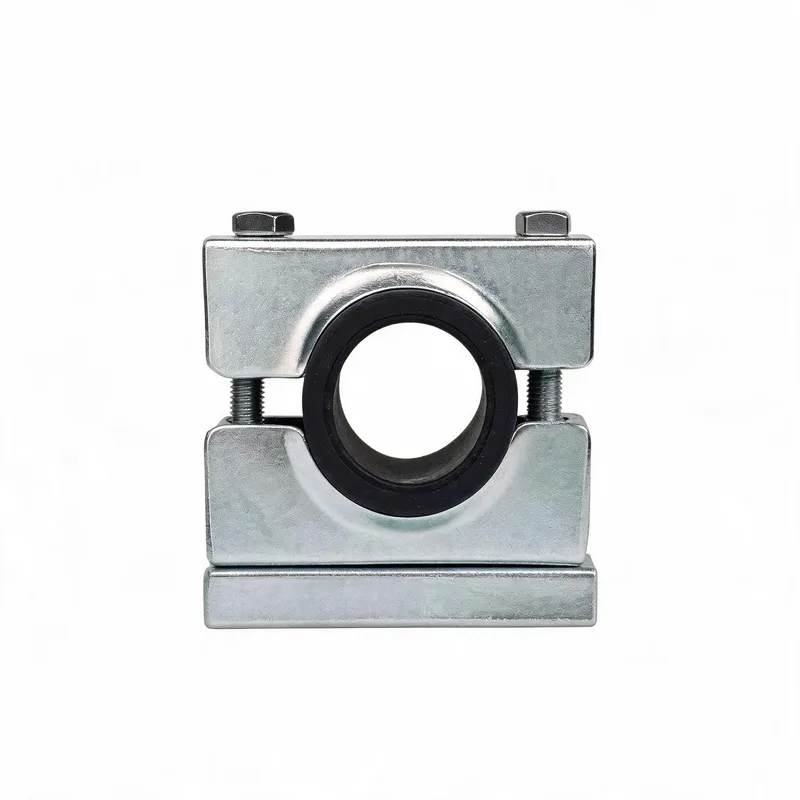
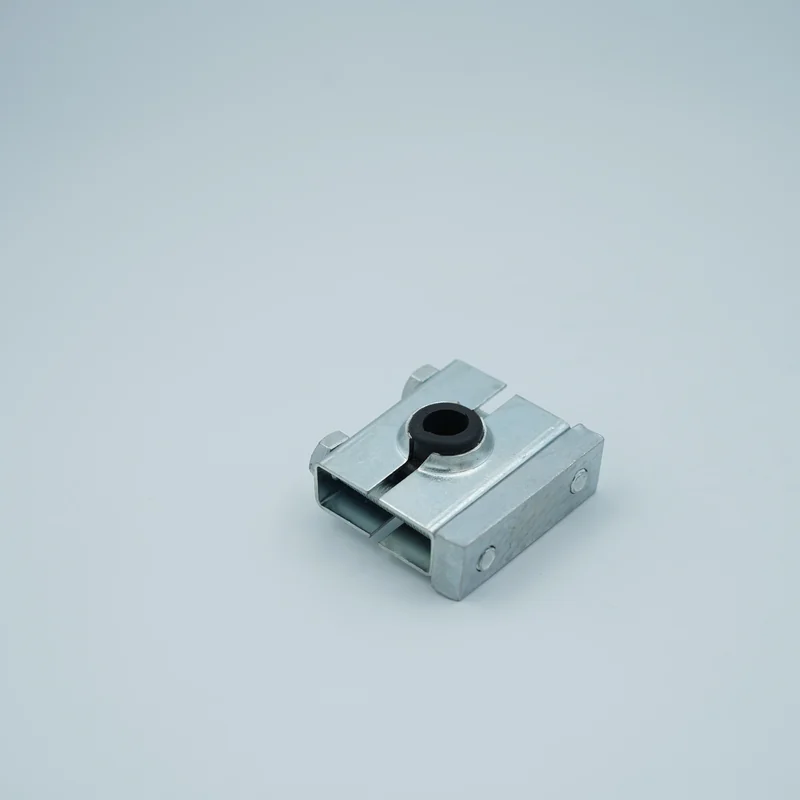
The practical rule: for pipe runs near occupied space — apartments, offices, hospital wards, hotel rooms — a rigid metal or hard-polymer clamp transmits pump vibration and flow noise directly into the wall or slab it is bolted to, where it radiates as audible sound rooms away from the pipe. A cushioned clamp with an elastomer insert (NBR, EPDM) — the part sold as an acoustic pipe clamp in building services — inserts a soft, resilient layer in that path and can cut the transmitted structure-borne noise substantially. But the isolation is not automatic: it only works when the insert stays resiliently soft under the clamp load and the disturbing frequency is above the natural frequency of the pipe-on-insert system. An over-compressed, too-stiff or wrong-material insert isolates little, which is why "cushioned clamp" alone is not a noise specification.
Pipe noise complaints in buildings are almost always a structure-borne problem, not an airborne one. The pump or the turbulent flow excites the pipe; the pipe passes that vibration through its supports into the building frame; and the frame — a large, light, well-coupled radiating surface — turns it back into airborne sound in a distant room. Sound-insulating the pump room does nothing about this path, because the energy never travels through the air; it travels through the steel and concrete. The support is therefore the control point, and the clamp is where the isolation is either designed in or lost.
Building pipe noise is structure-borne: a rigid clamp transmits pump and flow vibration into the slab, which radiates it as sound rooms away. An elastomer-insert (NBR/EPDM) cushioned clamp breaks that path — but only if the insert stays soft under load and the noise is above the mount natural frequency. Use cushioned clamps near pumps and occupied space; keep rigid clamps elsewhere.
Mounting methods at a glance
Key points
- Building pipe noise is structure-borne: the pipe feeds vibration through its supports into the slab or wall, which radiates it as sound in a distant room. Soundproofing the plant room does nothing — the support is the control point.
- A resilient mount only isolates above roughly 1.4× (√2×) its natural frequency; below that it transmits fully or amplifies at resonance. A soft insert lowers the natural frequency and widens the isolating band — so softness under the actual load, not just the word "rubber", is what isolates.
- Research on rubber vibration isolators shows their dynamic stiffness is higher than the static value and rises with frequency and pre-compression — a real insert is stiffer in service than a static datasheet implies, so noise-critical selection should not assume the soft static number.
- Match the insert to the fluid and environment, not just the noise: NBR suits mineral oil, EPDM suits water and ozone/UV outdoors. A chemically wrong insert hardens or swells, loses resilience and stops isolating long before it visibly fails.
- For the worst cases — a pump room directly above or beside bedrooms — a cushioned clamp alone may not be enough; add a separate resilient support (isolator hanger or pad) so the isolation is two-stage rather than relying on the insert to do everything.
Clamp type vs structure-borne noise isolation
| Clamp type | Noise isolation | Where it fits |
|---|---|---|
| Bare metal clamp (no insert) | ★☆☆☆ None — rigid path | Away from occupied space; where metal is required for heat/fire |
| Rigid PP/PA clamp | ★★☆☆ Slight — hard polymer | General routing not near noise-sensitive rooms |
| NBR-cushioned clamp | ★★★★ Good — resilient layer | Pumps, chilled/heating water, oil lines near occupied space |
| EPDM-cushioned clamp | ★★★★ Good — water/ozone stable | HVAC water and outdoor lines near occupied space |
| Clamp + separate resilient mount | ★★★★ Best — two-stage | High-noise plant rooms above/beside sensitive rooms |
An elastomer insert isolates only when its static deflection under load places the system natural frequency well below the disturbing frequency. An insert chosen for grip and compressed hard gives little isolation; a noise-critical clamp needs the insert selected for resilience at the actual clamp load, not just presence of rubber.
Structure-borne vs airborne: why the clamp is the control point
Noise reaches a listener by two routes. Airborne sound travels through the air and is controlled by mass, sealing and absorption — a heavier wall, a sealed door, an acoustic lining. Structure-borne sound travels through solid materials as vibration and is controlled by breaking the solid path with a resilient (springy) element. Pipe noise in buildings is overwhelmingly the second kind: a circulating pump, a pressure-reducing valve, or simply turbulent flow at a bend excites the pipe wall; that vibration runs along the pipe and, at every rigid support, injects energy into the building structure. Because a concrete slab or a steel frame is a large, efficient radiator, the sound can re-emerge as an audible hum or rush in a room with no pipe in it at all — which is exactly why occupants report noise "from the walls" and why treating the plant room acoustically achieves nothing. The only place to stop this transfer is at the interface between pipe and structure, and that interface is the clamp. A rigid clamp is a hard bridge that passes vibration through almost unimpeded; a clamp with a resilient elastomer insert interposes a soft spring that reflects much of the vibrational energy back rather than letting it cross into the building. This is the same principle as a machine mounted on rubber feet, applied at every pipe support.
Why isolation depends on natural frequency, not just "having rubber"
A pipe sitting on a resilient insert is a simple spring-mass system, and such a system has a natural frequency set by the supported mass and the insert stiffness. The defining behaviour of any resilient mount is that it isolates only above roughly 1.4 times (√2 times) that natural frequency; between zero and the natural frequency it transmits the vibration almost fully, and right at the natural frequency it amplifies — resonance makes things worse, not better. This has a direct practical consequence for clamp selection. To isolate a pump running at, say, 25–50 Hz, the pipe-on-insert natural frequency must be pushed well below that, which means the insert must deflect softly under the pipe load. A hard insert, or a soft insert compressed almost solid by an over-torqued bolt, has a high natural frequency and provides little or no isolation across the frequencies that matter. Rubber also behaves differently under vibration than under a static push: published research on rubber vibration isolators shows the dynamic stiffness is higher than the static stiffness and increases with frequency and with pre-compression. In other words, a real insert in service is stiffer — and therefore isolates less — than its static load–deflection figure suggests. The takeaways for procurement are concrete: choose the insert grade and thickness for resilience at the actual clamp load; do not over-torque a noise-critical clamp; and for low-frequency, high-energy sources near sensitive rooms, do not expect a thin insert to solve the problem on its own.
Where pipe noise shows up — the building-services pattern
Across building-services installations the noise complaints cluster at a predictable set of positions, and the reason is where vibration energy is highest and occupied space is closest. Circulating-pump discharge and suction lines are the classic source: the pump is a continuous excitation, and the first few clamps on each side carry the strongest vibration into the structure. Pressure-reducing and control valves generate broadband flow noise that the downstream pipe then transmits. Long straight risers passing through occupied floors act as conduits, injecting noise at every floor-slab penetration clamp. And any pipe clamped hard to a lightweight partition — a plasterboard wall, a raised floor, a suspended ceiling grid — turns that light panel into a loudspeaker. The established building-services response is not exotic: use cushioned (resilient-insert) clamps on pump-adjacent lines and anywhere pipework runs near or through occupied rooms, keep rigid metal clamps for plant-room interiors and high-temperature runs away from occupied space, and for the difficult cases — a plant room stacked directly above bedrooms — add a separate resilient hanger or isolation pad so the pipe is isolated in two stages. Specifications that name the noise-sensitive zones explicitly, rather than leaving clamp choice to a single default, are the ones that avoid the expensive retrofit of re-clamping an occupied building after handover.
What to write in the RFQ for noise-sensitive pipework
A clamp schedule can only control noise if the RFQ says where noise matters and what excites it. Four lines carry the information a supplier needs. State the noise-sensitive locations: which pipe runs are near, above or through occupied rooms, so cushioned clamps and resilient supports can be placed there rather than uniformly. State the excitation: pump type and running speed, control valves, and whether the concern is a continuous pump hum or intermittent flow noise, because the frequency content sets how soft the insert has to be. State the fluid and environment so the insert material is right — NBR for mineral oil, EPDM for water and outdoor ozone/UV exposure — since a chemically wrong insert hardens and stops isolating. And state whether a two-stage solution is expected for the worst positions (plant room over occupied space), so a separate resilient support can be quoted alongside the clamp rather than discovered as a shortfall after commissioning. WeiQue supplies cushioned DIN 3015 clamps with NBR and EPDM inserts and rigid standard, heavy and metal clamps; tell us the noise-sensitive zones and the excitation sources with your line list and we will mark which positions should use cushioned clamps and which can stay rigid, rather than pricing the whole run one way.
Frequently asked questions
Why does soundproofing the pump room not stop the pipe noise?
Because the noise is structure-borne, not airborne. The pump vibration travels through the pipe and its rigid supports into the building slab and walls, which radiate it as sound in a distant room. That energy never passes through the air in the plant room, so acoustic lining there does nothing. The fix is at the support: a resilient (cushioned) clamp that breaks the solid path.
Does any cushioned clamp reduce pipe noise?
Not automatically. An elastomer insert isolates only when it stays resiliently soft under the clamp load and the disturbing frequency is above the natural frequency of the pipe-on-insert system. An over-torqued or too-stiff insert isolates little, and rubber is stiffer under vibration than its static datasheet suggests. Select the insert for resilience at the actual load, and do not over-tighten a noise-critical clamp.
NBR or EPDM insert for a noise-sensitive water line?
Both isolate well; choose by fluid and environment. EPDM suits water, chilled/heating HVAC lines and outdoor ozone/UV exposure. NBR suits mineral oil. A chemically wrong insert hardens or swells, loses resilience and stops isolating long before it visibly fails — so match the insert to the service, not just to the noise requirement.
Related WeiQue series


Recommended reading
References
Further reading: pipe noise in buildings is structure-borne, controlled by resilient isolation at the support; isolation follows the transmissibility relation of a spring-mass system (isolation only above √2 × the natural frequency). Open-access research below covers the dynamic stiffness of rubber vibration isolators and elastomer-based vibration isolation.
- Using Waveguides to Model the Dynamic Stiffness of Pre-Compressed Natural Rubber Vibration Isolators — Polymers 13(11):1703 (MDPI, open access)
- Estimation of the Complex Dynamic Stiffness of Inflated Rubber Diaphragms in Pneumatic Springs Using Finite Element Method — Sensors 20(23):6728 (MDPI, open access)
- Vibration Isolation Performance of an Adaptive Magnetorheological Elastomer-Based Dynamic Vibration Absorber — Actuators 11(6):157 (MDPI, open access)