
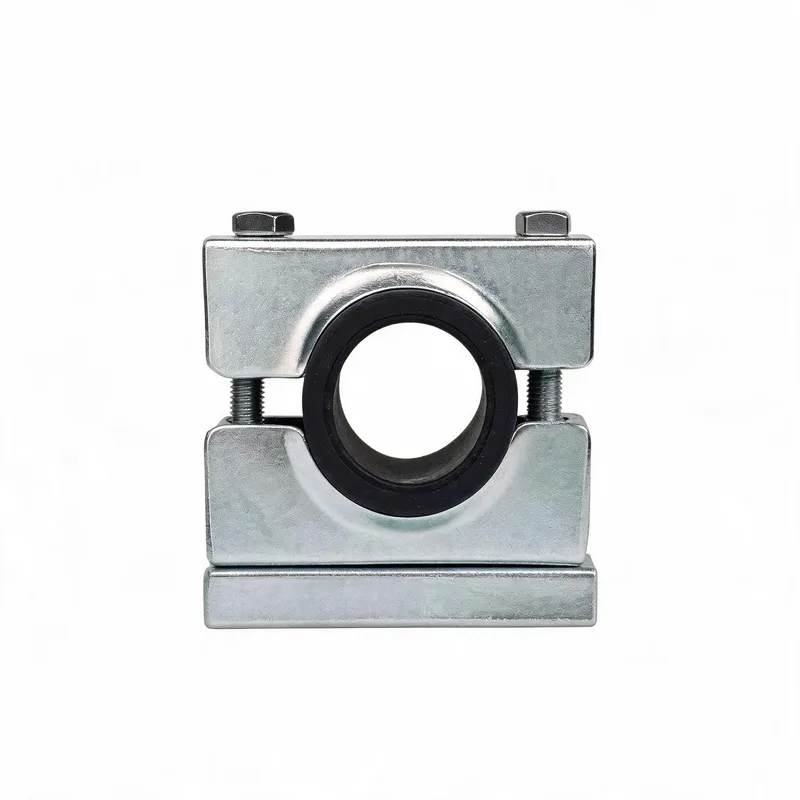
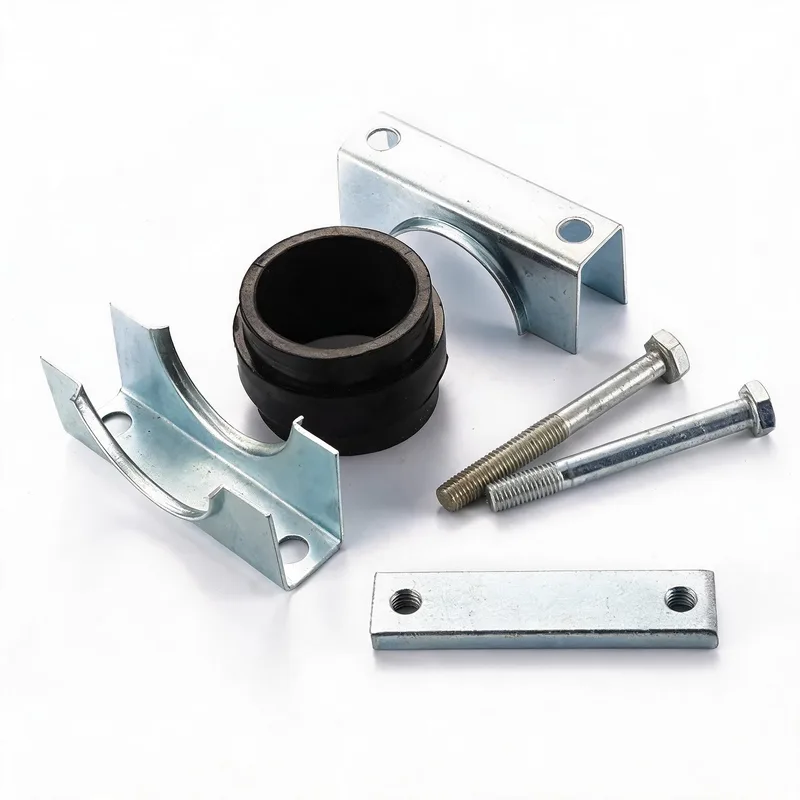
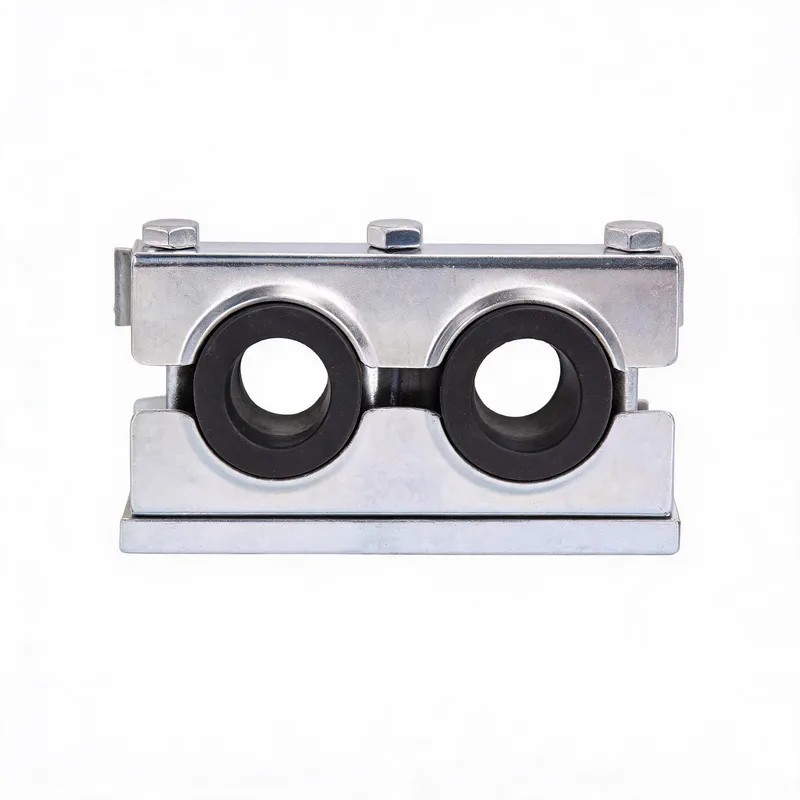
Cushioned pipe clamps use a rubber or elastomer insert between the pipe surface and the clamp body to absorb vibration, reduce structure-borne noise and protect the pipe surface from mechanical damage. The rubber insert is the functional core of the clamp — it determines the vibration isolation performance, the chemical and temperature service limits, and the long-term durability of the assembly. Choosing the wrong rubber compound for the service environment is one of the most common causes of premature cushioned clamp failure.
The three most common rubber materials for DIN 3015 pipe clamp inserts are NBR (nitrile butadiene rubber), EPDM (ethylene propylene diene monomer) and FKM (fluoroelastomer, commonly known by the brand name Viton). Each has distinct strengths and weaknesses: NBR is the standard choice for hydraulic and lubrication systems because of its excellent oil resistance; EPDM is preferred for water, steam and outdoor weathering because of its ozone and UV resistance; and FKM handles the widest range of chemicals and the highest temperatures but at significantly higher cost.
This guide explains the properties, service limits and selection criteria for each rubber type in pipe clamp applications.
Related product photos
Typical use cases
- NBR is the default for hydraulic oil, lubrication oil and fuel exposure — do not use EPDM near hydrocarbons
- EPDM is the default for water, steam, outdoor weathering and ozone exposure — do not use NBR outdoors long-term
- FKM handles the widest chemical and temperature range but costs 5–10× more than NBR or EPDM
- Specify rubber hardness (Shore A) to match vibration isolation needs — softer rubber absorbs more vibration
Rubber insert material comparison
| Property | NBR (nitrile) | EPDM | FKM (Viton) |
|---|---|---|---|
| Oil / fuel resistance | Excellent | Poor — swells and degrades | Excellent |
| Water / steam resistance | Moderate | Excellent | Good |
| Ozone / UV / weathering | Poor — cracks over time outdoors | Excellent | Excellent |
| Temperature range (continuous) | −30 to +100 °C | −40 to +130 °C | −20 to +200 °C |
| Relative cost | 1× (baseline) | 1–1.5× | 5–10× |
Temperature ranges are approximate and vary with rubber compound formulation, hardness and load. Always confirm the specific compound data sheet for the exact service limits.
NBR: the standard choice for oil and hydraulic environments
NBR (nitrile butadiene rubber, also called Buna-N) is the default rubber insert material for DIN 3015 cushioned pipe clamps supplied to hydraulic, lubrication and fuel system applications. Its key property is excellent resistance to petroleum-based oils, hydraulic fluids (mineral oil groups HH, HL, HLP, HV), fuels, greases and many industrial solvents. When hydraulic fluid drips or sprays onto the clamp during a fitting leak or hose failure, an NBR insert maintains its dimensions, hardness and elasticity — it does not swell, soften or dissolve. NBR is available in hardness ranges from approximately 40 to 90 Shore A, with 55–70 Shore A being the most common for pipe clamp inserts. The trade-off: NBR has poor resistance to ozone, UV radiation and weathering. Exposed to outdoor air and sunlight for extended periods, NBR develops surface cracks (ozone cracking) that propagate under stress and eventually compromise the insert. For indoor hydraulic and lubrication applications, this is not a concern. For outdoor installations, EPDM or FKM should be considered.
EPDM: the choice for water, steam and outdoor exposure
EPDM (ethylene propylene diene monomer) is the preferred rubber insert material for water systems (chilled water, hot water, cooling water, fire protection), steam and condensate lines, and any outdoor installation where ozone and UV exposure is a concern. EPDM has outstanding resistance to ozone cracking, UV degradation and weathering — it can operate outdoors for decades without surface cracking. It also handles hot water and low-pressure steam (up to approximately 130 °C continuous) better than NBR. The critical limitation: EPDM swells rapidly in contact with petroleum oils, hydraulic fluids, fuels and aromatic solvents. An EPDM insert on a hydraulic line will swell, lose grip on the pipe and eventually extrude out of the clamp body. Never use EPDM inserts on oil or fuel lines. For building services (HVAC chilled and heating water, domestic water, fire sprinkler), EPDM is the correct standard choice. For outdoor pipe racks carrying water or non-hydrocarbon fluids, EPDM provides the longest insert life.
FKM: the premium choice for chemicals and high temperature
FKM (fluoroelastomer, commonly sold under the brand names Viton, Tecnoflon or Dai-El) offers the broadest chemical resistance and the highest continuous temperature rating of the three common rubber types. FKM resists petroleum oils, fuels, aromatic solvents, many acids, chlorinated solvents and oxidising chemicals — essentially combining the oil resistance of NBR with the chemical breadth that neither NBR nor EPDM can match. Its continuous temperature rating reaches approximately 200 °C (some grades to 230 °C), far exceeding NBR and EPDM. FKM is the correct choice when the rubber insert is exposed to aggressive chemicals (chemical plants, pharmaceutical, semiconductor), very high temperatures (boiler areas, furnace proximity, steam systems above 130 °C), or a combination of oil and weathering exposure that neither NBR nor EPDM alone can handle. The trade-off is cost: FKM inserts typically cost 5–10 times more than equivalent NBR or EPDM inserts. FKM also has limited resistance to ketones (acetone, MEK), esters and some amines — check compatibility before specifying for these chemicals.
Rubber hardness and vibration isolation performance
The hardness of the rubber insert (measured in Shore A) directly affects the vibration isolation performance and the load-carrying capacity of the clamp. Softer rubber (40–55 Shore A) provides better vibration isolation because it deforms more under load, absorbing more vibration energy — but it also allows more pipe movement under static weight and may not grip the pipe firmly enough in vertical runs. Harder rubber (65–90 Shore A) provides firmer pipe support and higher load capacity but transmits more vibration through the insert. The standard hardness for DIN 3015 cushioned pipe clamp inserts is typically 55–65 Shore A, which provides a practical balance between vibration isolation and load support. For applications where vibration isolation is the primary requirement (pump rooms, compressor packages, building HVAC near occupied spaces), specify the softer end of the range. For applications where pipe weight or vertical pipe support is the primary concern, specify the harder end. Do not assume that all rubber inserts from different suppliers have the same hardness — request the Shore A value and the rubber compound designation when comparing products.
Common mistakes: using the wrong rubber for the environment
The most frequent rubber selection mistake is using EPDM inserts on hydraulic or lubrication lines. This happens when a maintenance team replaces a worn clamp with whatever cushioned clamp is available in the stores, without checking the rubber type. The EPDM insert swells within weeks to months in contact with hydraulic oil, loses its shape, and either extrudes from the clamp body or becomes so soft that it no longer supports the pipe. The second most common mistake is using NBR inserts on outdoor water piping. The NBR insert develops ozone cracks after one to three years of outdoor exposure, depending on UV intensity and ozone concentration. The cracks propagate, the insert hardens and eventually crumbles, leaving the pipe unsupported. Both failures are entirely preventable by checking the rubber type before installation. If the rubber type is not marked on the insert (many generic inserts have no marking), request the material data sheet from the supplier. When in doubt: NBR for oil, EPDM for water and outdoor, FKM when neither of the other two works.
Related WeiQue series


Recommended reading
References
These pages summarize public standard metadata and industry application information. They do not reproduce the paid DIN standard text.