
Wind turbine nacelles and tower sections present a combination of challenges that most industrial pipe support applications do not: sustained broadband vibration, low-temperature startup exposure, limited service access at hub height, aggressive environmental loads (salt, humidity, UV) and long inspection intervals.
Selecting the right DIN 3015 pipe clamp series, insert material, mounting method and hardware finish for each line section helps control fatigue, prevents loosening and extends the service interval between tower climbs.
Related product photos
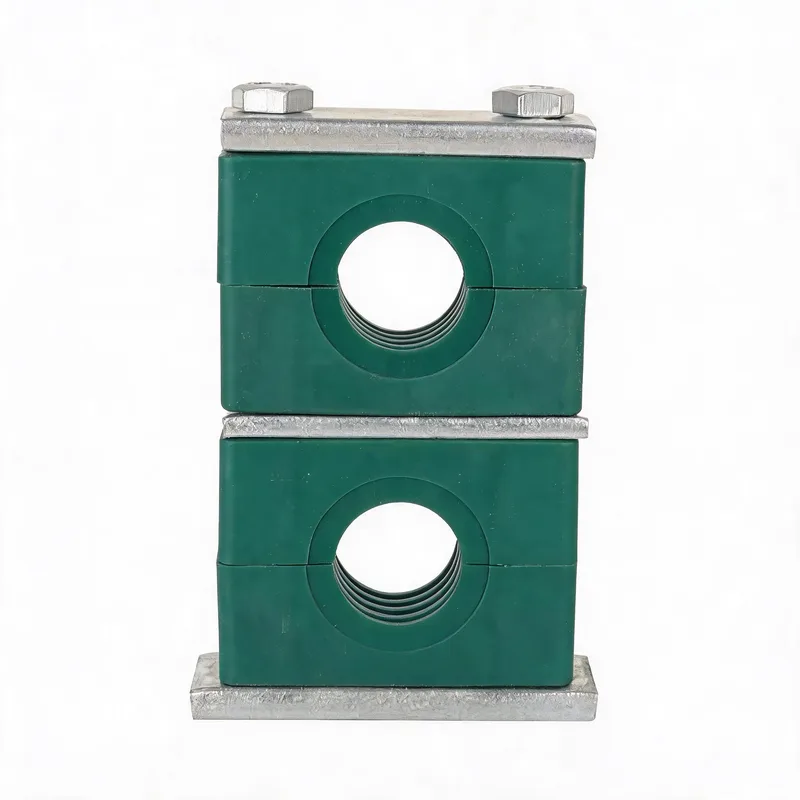
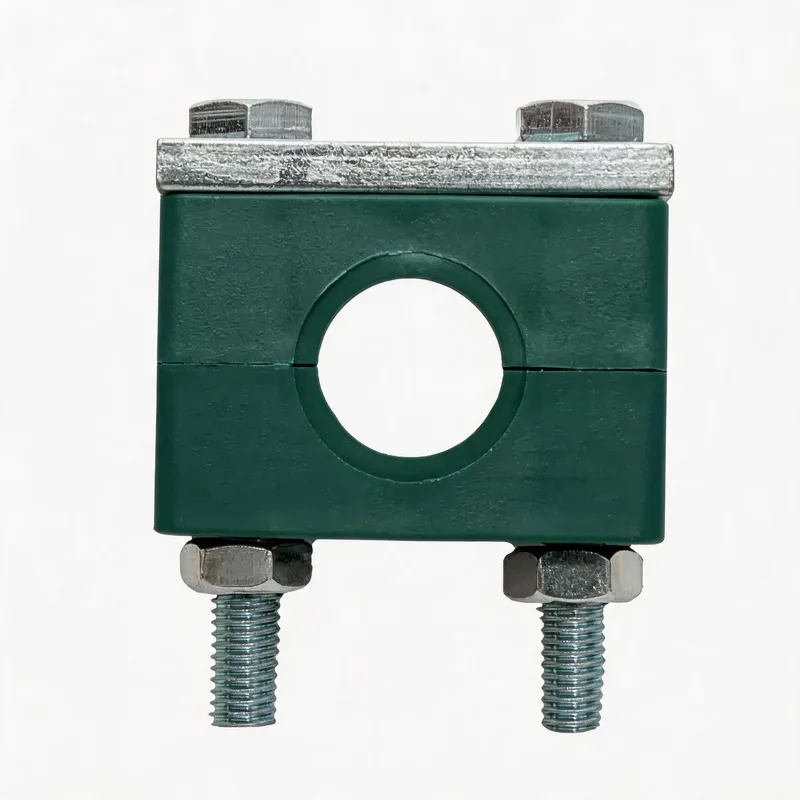
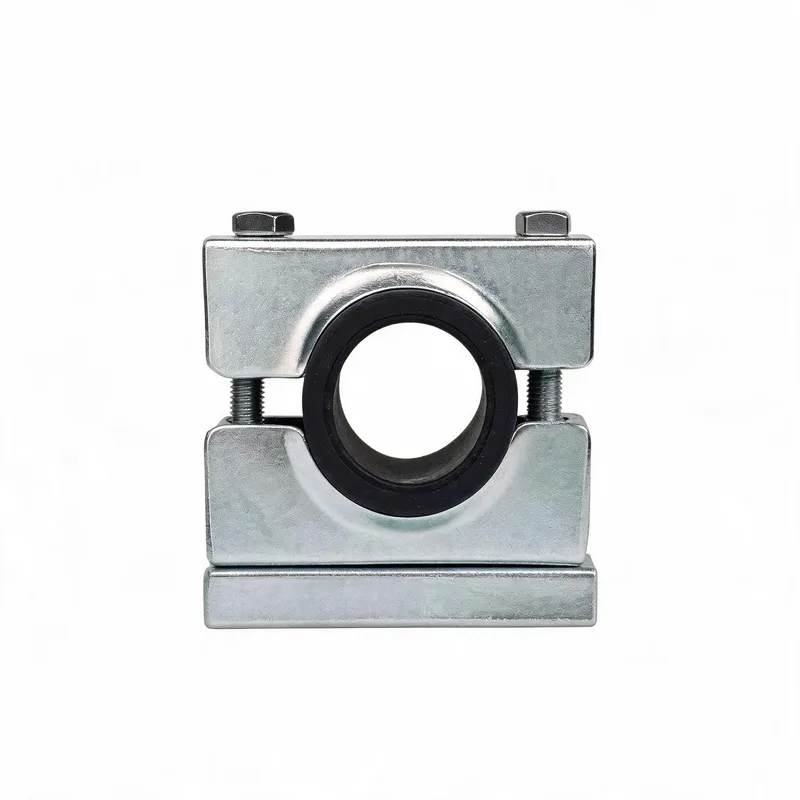
Typical use cases
- Use heavy series or cushioned clamps on lines within 3 m of pumps, gearboxes and pitch cylinders
- Confirm insert material retains strength at site minimum temperature (often −30 to −40 °C)
- Specify stainless or hot-dip galvanized hardware for offshore and coastal projects
- Plan clamp spacing and locking to minimise unplanned tower climbs for retightening
Wind turbine pipe clamp selection by zone
| Zone / line | Recommended series | Key consideration |
|---|---|---|
| Nacelle — pump and gearbox hydraulic lines | WQH heavy or WQF cushioned (G30) | High vibration, pressure pulsation, limited service access |
| Nacelle — cooling water and lubrication lines | WQL standard (G2/G3) welded base | Moderate vibration, fixed bracket positions from assembly |
| Pitch system — cylinder and accumulator lines | WQH heavy (H1–H4) or WQF cushioned | Dynamic load cycling, confined hub space |
| Tower — internal vertical hydraulic risers | WQL standard or WQH heavy, stacking (G18) | Axial pipe weight, thermal movement, long vertical spans |
Offshore projects should add corrosion protection and stainless hardware review to every zone.
Vibration sources in a wind turbine
Vibration in a wind turbine nacelle comes from multiple sources: rotor imbalance, gearbox meshing, hydraulic pump pulsation, yaw drive actuation and blade pitch cycling. These sources overlap in frequency and amplitude, creating broadband vibration that is more demanding than a single-frequency pump installation. Pipe clamps near the gearbox, main pump and pitch cylinders should use DIN 3015-2 heavy series or cushioned WQF clamps with NBR inserts to attenuate vibration transfer to the pipe and prevent bolt loosening.
Low-temperature material selection
Many wind farm sites experience sustained temperatures below −20 °C during winter startup. Standard PP clamp bodies remain serviceable down to approximately −20 °C, but become brittle below that. PA (polyamide) retains better impact strength at lower temperatures and is often preferred for nacelle and hub applications where the minimum site temperature reaches −30 to −40 °C. Confirm the actual minimum temperature at hub height, not ground level, because wind chill and radiant cooling at 80–160 m can be significantly lower than the nearest weather station reading.
Mounting methods in nacelle and tower
Nacelle pipe clamps are typically mounted on welded base plates or stiffened brackets that are positioned during nacelle frame assembly. The bracket location is fixed before pipes are installed, so the clamp position must be coordinated with the piping layout drawing. In the tower section, vertical hydraulic risers are supported by clamps bolted to flanged brackets or welded tabs at intervals along the tower wall. Use stacking clamps (G18) only where the stacking arrangement does not block inspection or hose-change access. Avoid rail-nut mounting in high-vibration nacelle areas unless the rail is independently secured against lateral movement.
Offshore and coastal corrosion protection
Offshore wind turbines and coastal installations require corrosion protection beyond standard zinc plating. Salt-laden humid air, condensation cycles inside the tower and nacelle, and long intervals between inspections mean that standard zinc-plated carbon steel bolts can develop red rust within one to two years. Specify 316L stainless steel fasteners and consider stainless base plates or hot-dip galvanized mounting brackets. For the clamp body itself, PP and PA are inherently corrosion-resistant, but confirm that all metallic contact surfaces — bolt heads, cover plates, rail nuts — are protected to the same corrosion grade as the rest of the tower internals.
Bolt locking and inspection intervals
Every tower climb for retightening costs time and money. Wind turbine pipe clamp bolts should be tightened to the specified torque with a calibrated wrench, and a witness mark should be applied on every bolt at commissioning. Use positive locking methods — lock nuts, locking plates or thread-locking adhesive — rather than relying on friction alone. At scheduled inspections, check witness marks for rotation, inspect clamp bodies for cracking (especially PP at low temperature), and verify that no pipe has shifted axially in a vertical run.
Cross-link: WindEnergyClamps.com
For a complete wind-turbine pipe clamp specification resource — organised by installation zone, environmental load category and project documentation requirements — visit our specialist site WindEnergyClamps.com. That site covers nacelle, hub, tower and foundation zones with product selection, quantity estimation and downloadable specification templates.
RFQ data for wind turbine pipe clamps
Send tube material and OD for each line, turbine model and rated power, nacelle or tower zone, site minimum temperature at hub height, onshore or offshore, vibration source proximity, mounting method, bolt locking preference, corrosion protection requirement, applicable OEM or project specification, quantity per turbine and number of turbines.
Related WeiQue series


Recommended reading
References
These pages summarize public standard metadata and industry application information. They do not reproduce the paid DIN standard text.