
Shipboard pipe supports face a combination of demands that land-based installations rarely encounter together: persistent salt spray, hull vibration from engines and propulsion, compact compartment layouts that make rework expensive, and classification society documentation requirements that govern material, installation and inspection from keel-laying to delivery.
The most common failure mode for marine pipe clamps is not mechanical overload — it is corrosion-driven loss of fastener preload, crevice attack on base plates, and galvanic couples between dissimilar metals in a salt-air environment. The second most common problem is routing inflexibility: clamp positions are fixed to brackets welded during hull assembly, and any mismatch with the pipe routing discovered later is costly to correct in a closed compartment.
This guide covers clamp selection from the perspective of a marine engineer or outfitter who needs to match DIN 3015 pipe clamp hardware to shipyard practice, classification expectations and the salt-water service environment.
Related product photos
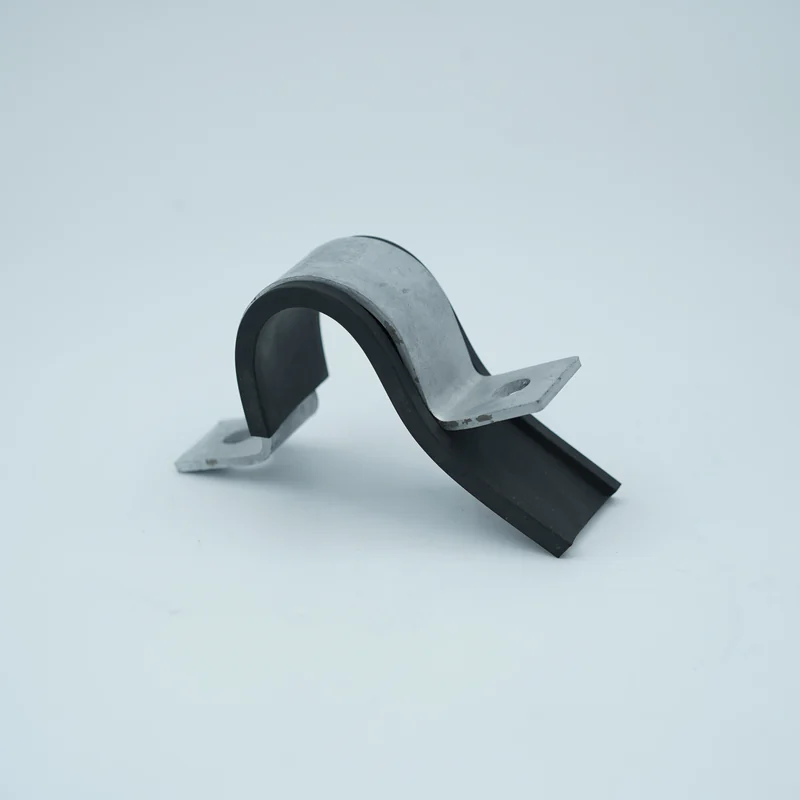
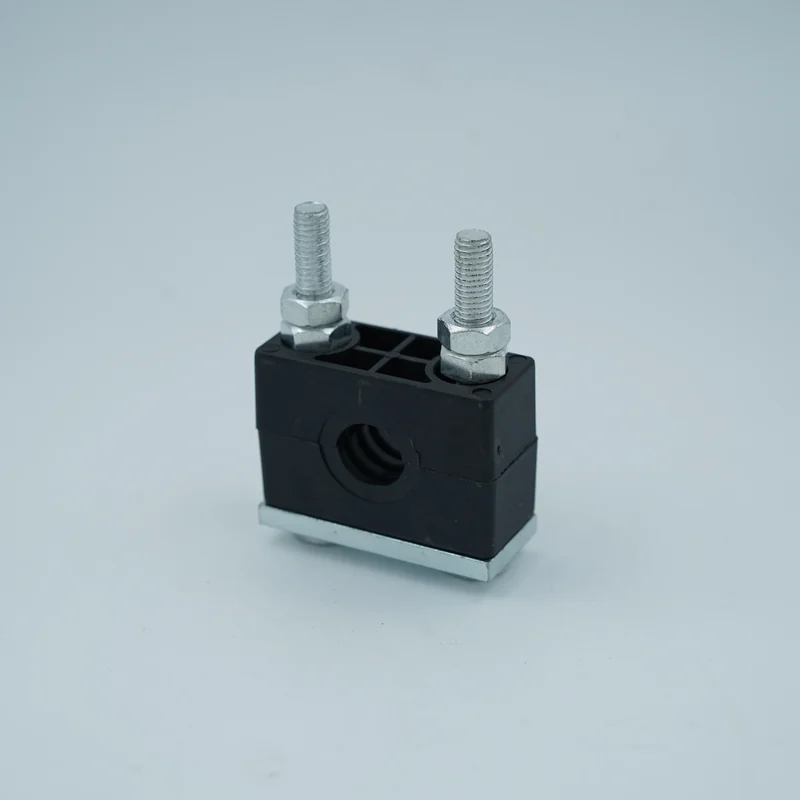
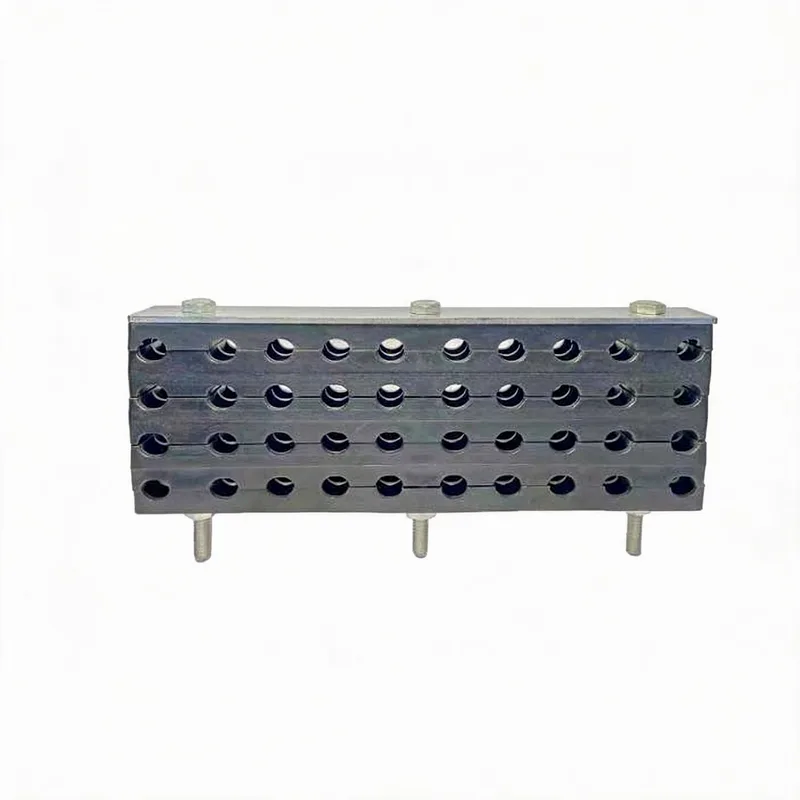
Typical use cases
- Specify 316L stainless for all metallic clamp hardware in engine rooms and exposed decks
- Coordinate clamp bracket positions with the pipe routing drawing before hull welding
- Use cover-plate series for positive pipe retention against hull vibration and sea state loads
- Match corrosion protection grade across the full assembly — body, bolt, cover plate and base
- Maintain classification-ready documentation: material certificates, torque records, inspection logs
Pipe clamp selection by ship zone
| Ship zone | Typical lines | Recommended series | Corrosion grade |
|---|---|---|---|
| Engine room — main hydraulic | Steering gear, stabiliser, winch HPU | G3/G6 cover plate or G30 shockproof | 316L stainless hardware |
| Engine room — cooling / lube | LO supply, SW/FW cooling, bilge | G2/G4 welded base | 316L or HDG + marine paint |
| Deck machinery | Crane, mooring winch, hatch cover HPU | G3/G6 cover plate + G30 near pumps | 316L stainless throughout |
| Superstructure interior | HVAC, potable water, fire suppression | G1/G2 standard series | Zinc plated or A2 stainless |
| Tank top and double bottom | Ballast, fuel transfer, bilge suction | G4/G5 long welded base | 316L or epoxy-coated + 316L bolts |
| Offshore platform / FPSO | Process, firewater, hydraulic, instrument | G3/G6/G16 cover plate, full 316L | 316L all components, NORSOK M-501 |
Recommendations are general guidance. Actual specifications depend on the classification society rules, flag state requirements and project specification for the vessel.
Classification society expectations for pipe supports
Classification societies (DNV, Lloyd's Register, Bureau Veritas, ABS, CCS and others) do not typically certify individual pipe clamps, but they do survey the installed piping system and expect that supports are adequate for the service loads, materials are documented, and installation quality is recorded. In practice this means the shipyard or outfitter must be able to show: material certificates or declarations for metallic components (bolts, cover plates, base plates); evidence that the clamp rating suits the pipe size, weight and service vibration; and installation records showing torque values and inspector sign-off. Maintaining this documentation from the beginning of procurement — not reconstructing it before class survey — saves time and avoids delays at delivery.
Why cover-plate clamps are the marine default
In a land-based workshop, a standard open clamp (DIN 3015-1 without cover plate) holds the pipe in a cradle under gravity — the pipe sits in the clamp and gravity keeps it there. On a ship, this assumption fails. Hull roll, pitch and heave can lift a pipe out of an open cradle, and engine vibration can walk a pipe axially out of position over time. Cover-plate clamps (G3, G6, G12, G16) positively restrain the pipe in all directions: the cover plate is bolted across the top of the clamp body, enclosing the pipe. This is why cover-plate configurations dominate marine specifications — they turn the clamp from a passive cradle into a positive restraint. Use open clamps only in sheltered interior locations (HVAC lines in accommodation spaces, potable water in the galley) where accelerations are low and a pipe dislodging would not cause a safety hazard.
Corrosion protection strategy for shipboard clamps
The marine environment is unforgiving to underspecified corrosion protection. Even "dry" engine rooms have condensation, bilge splash and humid salt air drawn in through ventilation. The practical rule is: if the compartment can see salt air, specify 316L stainless for all metallic clamp hardware — bolts, nuts, washers, cover plates and base plates. PP and PA clamp bodies are inherently salt-resistant and need no coating. The weak point in many marine clamp assemblies is a single zinc-plated washer or carbon steel rail nut mixed into an otherwise stainless assembly. This creates a galvanic couple that corrodes the zinc or carbon steel part rapidly, transferring the failure to the cheapest component. A consistent material specification — "all metallic parts 316L" for engine rooms and exposed areas — eliminates this risk entirely. For protected interior spaces (accommodation, bridge equipment rooms), A2 stainless (304) or quality zinc plating may be acceptable, depending on the flag state and class requirements.
Hull vibration and pipe clamp loading
Hull vibration comes from the main engine firing frequency, propeller blade pass, generator sets and seaway-induced hull flexure. These vibration sources can loosen inadequately secured fasteners over time — particularly in the aft section near the propeller and in way of the engine room. Pipe clamps in high-vibration zones should use positive bolt-locking methods (lock nuts, Nord-Lock washers or thread adhesive) rather than relying on friction alone. The DIN 3015-2 heavy series and shockproof WQL G30 series are designed for higher dynamic loads; use them near pumps, steering gear and any machinery with pulsating hydraulic flow. Standard series G1/G2 are adequate for static or low-vibration runs in the superstructure. When in doubt, step up to the heavy series — the cost difference per clamp is small compared to the cost of a pipe failure at sea.
Compact compartment routing and clamp spacing
Shipboard compartments are compact by design. Hydraulic lines, cooling water pipes, fuel lines, air lines and cable trays compete for the same routing channels along bulkheads, overheads and tank tops. Clamp spacing that works on a land-based pipe rack may be too sparse for a ship, where hull movement and vibration add dynamic loads between supports. Reduce spacing near direction changes, penetrations and hose transitions — these are the points where unsupported pipe length creates the most bending stress under ship motion. Use stacking clamps (G18) where two or three parallel lines share a single bracket and inspection access is not blocked. Use rail-mounted clamps (G10/G12) where pipe positions need adjustment during outfitting — the rail allows sliding the clamp along the bracket without re-welding.
Welded bracket positioning and outfitting sequence
In modern shipbuilding, pipe support brackets are welded to the hull structure during block assembly — before the pipe is installed. This means the bracket position is fixed early, and moving it later requires grinding, re-welding, NDT and re-painting in a finished compartment. The most cost-effective practice is to coordinate bracket positions with the 3D pipe routing model before block fabrication begins. Mark bracket positions on the steel during cutting or sub-assembly, and verify them against the routing drawing before the block is turned or joined. Rail-nut brackets (G9/G10/G12) provide some adjustment tolerance — the clamp can slide along the rail — but the rail itself is still welded at a fixed location. For critical hydraulic runs (steering gear, stabiliser, cargo pump), the routing layout should be approved by the system integrator before bracket welding begins.
Anti-seize and bolt galling prevention
Stainless steel bolts gall — the contact surfaces cold-weld during tightening, making the bolt impossible to remove without destruction. This is a particular problem in marine applications where 316L bolts are standard and bolt removal for inspection or pipe rerouting is routine during the vessel's life. Apply anti-seize compound (molybdenum disulfide, copper-based or PTFE-based) to the bolt threads and under the bolt head before assembly. Alternatively, specify wax-patched or PTFE-coated stainless bolts from the supplier. When anti-seize is used, the effective friction coefficient changes, which affects the relationship between applied torque and actual bolt preload. Follow the anti-seize manufacturer's torque reduction recommendation (typically 15–25 % reduction from dry torque values) or use the supplier's torque table for lubricated fasteners.
Hose-to-pipe transition supports
Many shipboard hydraulic systems use hose sections at equipment connections to absorb alignment offset and vibration. The point where the hose transitions to rigid pipe is a critical support location. Without a clamp close to the transition, the rigid pipe acts as a cantilever loaded by hose weight and movement, concentrating bending stress at the first unsupported point. Place a clamp within one to two pipe diameters of the hose fitting. Use a shockproof G30 or heavy-series cover-plate clamp at this location to absorb the dynamic loads transmitted through the hose. Confirm that the hose bend radius at the transition meets the hose manufacturer's minimum — an over-tight bend near the clamp can fatigue the hose inner liner.
RFQ data for shipboard pipe clamps
Send pipe OD and material for each circuit, ship type and classification society, compartment or zone (engine room, deck, accommodation, tank top, offshore), vibration source proximity, required corrosion protection grade and material standard, cover plate requirement (yes/no per zone), mounting method (welded base, rail-nut, body-only), applicable project specification or shipyard standard, anti-seize and bolt-locking preference, material certificate requirements, quantity per vessel and number of vessels in the series.
Related WeiQue series


Recommended reading
References
These pages summarize public standard metadata and industry application information. They do not reproduce the paid DIN standard text.