
Steel plants, foundries and other metallurgical facilities combine conditions that test pipe clamp systems from every direction: radiant heat from furnaces, ladles and rolling stock can push clamp body temperatures well above normal industrial ranges; thermal expansion of long hydraulic runs creates axial loads on fixed supports; mill scale, slag fragments and metallic dust coat everything and infiltrate crevices; mechanical impact from crane operations, charging equipment and rolling vibration can damage light components; and water quench spray and steam create localised corrosion pockets even in otherwise dry areas.
Pipe clamps in these environments support hydraulic supply and return lines for mill stands, descalers, shears and transfer tables; lubrication circuits for bearings, gears and roll necks; water cooling lines for furnace panels, mould jackets and roll cooling; and instrument tubing for pressure, temperature and flow measurement across the plant.
This guide covers the practical selection decisions for DIN 3015 pipe clamps in metallurgical service, with emphasis on heat, expansion, mechanical abuse and maintainability.
Related product photos
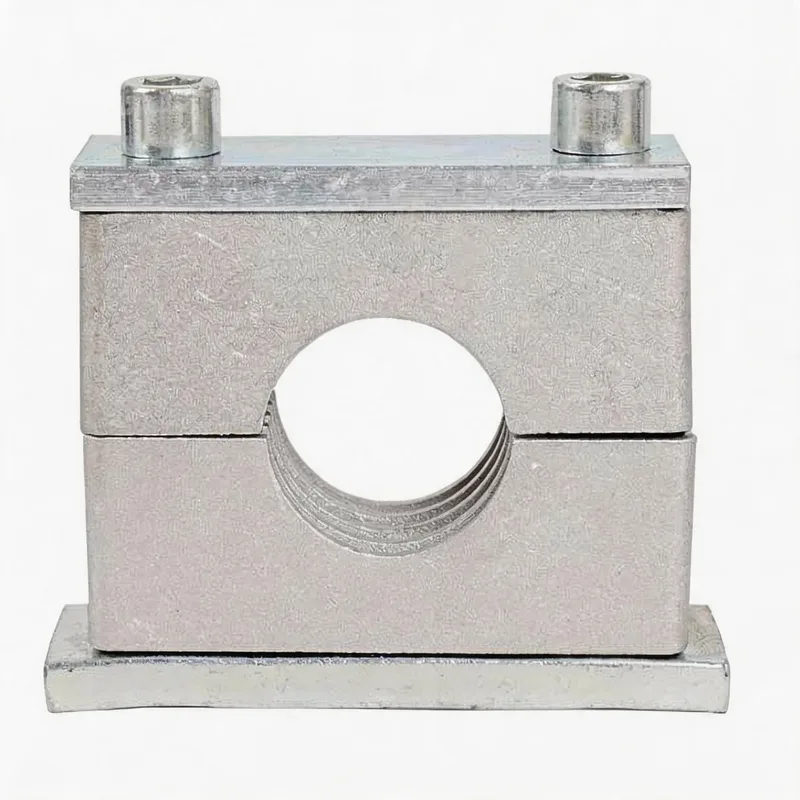
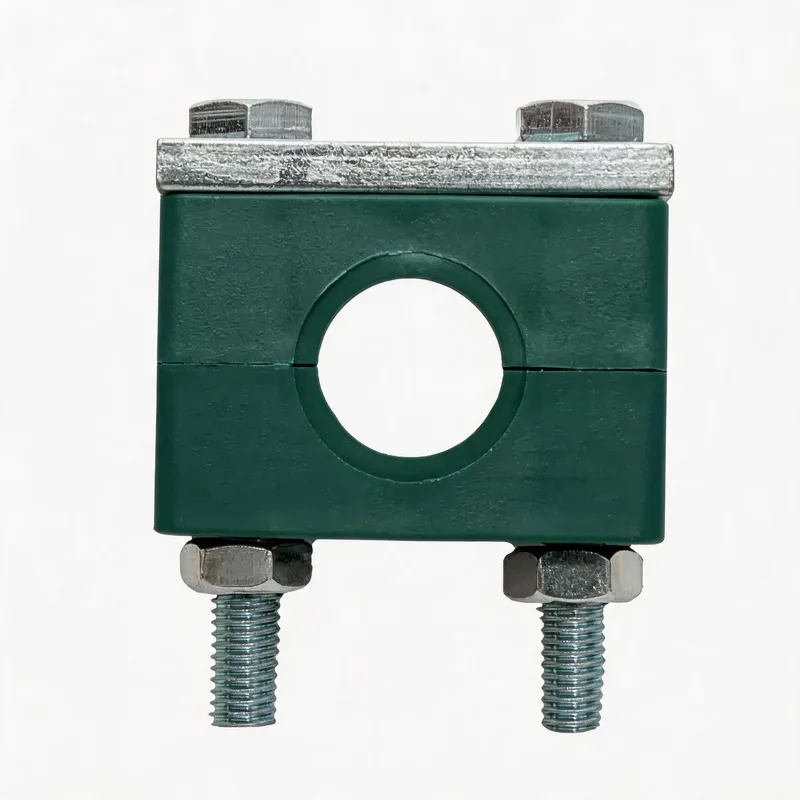
Typical use cases
- Measure or estimate clamp body temperature — not fluid temperature — before selecting body material
- Design fixed and guide clamp points to accommodate thermal expansion of long pipe runs
- Use heavy series or long welded-base clamps where mechanical impact is expected
- Protect fastener coatings from weld spatter and grinding debris during maintenance
Pipe clamp selection by steel plant zone
| Zone | Key challenge | Recommended clamp | Material note |
|---|---|---|---|
| Melt shop / furnace area | Radiant heat, slag splash, crane impact | G4/G5 long welded base, metal body | Metal or PA body; heat shield if needed |
| Rolling mill stands | Vibration, pressure pulses, water spray | G30 shockproof near pumps; G3/G6 cover plate | HDG or Dacromet fasteners |
| Cooling water headers | Large OD, heavy weight, thermal cycling | G4 long welded base; heavy series for >50 mm | HDG base plate + coated bolts |
| Hydraulic pump room | Pump pulsation, oil mist, indoor | G30 shockproof + G2 standard | Standard zinc or Dacromet |
| Outdoor pipe rack | Weather, dust, thermal expansion | G4/G5 welded base; G9 rail-nut for adjustment | HDG hardware minimum |
Zone boundaries and conditions vary by plant layout and production type. Confirm actual temperatures, vibration levels and chemical exposure at each clamp location with the plant engineering team.
Heat exposure and clamp body material limits
PP clamp bodies are rated for continuous service up to approximately 80–100 °C. PA bodies extend this to about 120–150 °C depending on grade and load. Near furnaces, ladles, reheating zones and hot rolling stands, radiant heat can push clamp body temperatures well above these limits even when the pipe itself carries cold fluid. The critical question is: what is the temperature at the clamp body, not in the pipe? Insulation on the pipe, air circulation patterns and distance from the heat source all affect the body temperature. If the clamp body temperature exceeds the polymer limit, the body softens, loses preload and eventually allows pipe movement. For locations where body temperature exceeds 100 °C, consider PA (higher limit), aluminium (up to ~200 °C) or carbon steel / stainless steel bodies. If the heat exposure is intermittent (such as when a ladle passes by), a heat shield between the heat source and the clamp assembly may allow a polymer body to survive.
Thermal expansion and fixed-guide clamp layout
Steel plants have long hydraulic and cooling water runs — 50 m, 100 m or more — that operate at elevated temperature. A 100 m carbon steel pipe heated from ambient to 80 °C expands by approximately 70 mm. If every clamp along that run is a fixed (anchor) clamp, the cumulative expansion force will overload the clamp bodies, shear bolts or buckle the pipe between supports. The solution is the same as for process piping: designate anchor points at fixed locations (near equipment connections, direction changes and major supports), and use guide clamps between anchor points to allow the pipe to slide axially while being restrained laterally. DIN 3015 standard series clamps with smooth PP inserts naturally allow limited axial sliding and function as guides. Heavy series cover-plate clamps or body-only clamps bolted tight function as anchors. Plan the anchor-guide layout on the pipe routing drawing before installation, and mark each clamp location as "fixed" or "guide" in the installation specification.
Dust, scale and mechanical protection
Mill scale, metallic dust and slag fragments accumulate on every horizontal surface in a steel plant, including pipe clamp tops, bolt heads and base plates. This debris is abrasive and can trap moisture, accelerating crevice corrosion under bolt heads and cover plates. It also makes visual inspection difficult — a bolt head buried under 10 mm of scale dust cannot be checked for witness mark rotation or rust without cleaning first. Use cover-plate clamps in dusty areas to protect the pipe seat from debris ingress. Specify hot-dip galvanized or Dacromet-coated fasteners rather than thin zinc plating, because the thicker coating survives abrasion from scale contact. Avoid rail-mounted systems in areas with heavy dust accumulation unless the rail channel can be protected or cleaned regularly, because debris filling the channel can prevent rail nut sliding and make position adjustment impossible.
Crane zones and impact-resistant clamp selection
Overhead cranes in melt shops, caster bays and rolling mills carry heavy loads (ladles, coils, slabs) and their movement creates risk of incidental contact with pipe runs that cross below the crane path. A standard PP clamp body struck by a swinging load or bumped by a crane grab can shatter instantly. In crane zones, use heavy-series metal-body clamps or protect the pipe run with a structural guard. Long welded-base clamps (G4/G5/G6) distribute impact load across a larger bracket area and are less likely to be dislodged by a glancing blow than a short welded-base clamp. For critical hydraulic lines running through crane zones, consider routing the lines below floor grating or behind structural steel to eliminate direct exposure.
Maintenance access and coating repair
Steel plant maintenance involves grinding, welding, oxy-fuel cutting and plasma cutting in close proximity to installed pipe clamps. Weld spatter, grinding sparks and cutting debris damage coatings on bolts, cover plates and base plates, creating initiation points for corrosion. After any hot work near pipe clamps, inspect the clamp hardware for coating damage and repair with cold galvanising compound, touch-up paint or replacement parts as needed. Clamp designs that allow bolt removal without disturbing the pipe position (standard series open clamps, rail-mounted clamps) make maintenance faster because the pipe can remain supported while hardware is inspected and replaced. Heavy series cover-plate clamps provide better pipe retention but require both bolts to be removed to lift the cover plate — plan scaffolding or access platform positions accordingly.
RFQ data for steel plant pipe clamps
Send pipe material and OD for each circuit, plant zone (melt shop, caster, rolling mill, pump room, pipe rack), estimated clamp body temperature, heat source type and proximity, pipe operating temperature and pressure, vibration source proximity, thermal expansion span length, mounting method (welded base, rail-nut, body-only on customer bracket), required clamp body material (PP, PA, aluminium, steel, stainless), fastener coating preference, crane zone exposure (yes/no), applicable plant or project specification, quantity by zone and clamp size.
Related WeiQue series


Recommended reading
References
These pages summarize public standard metadata and industry application information. They do not reproduce the paid DIN standard text.