
Pipe clamps on compressors, pumps, engines and vibrating equipment can fail not because the clamp is wrong, but because the fastener loosens over time. Research into threaded fastener loosening has consistently shown that transverse vibration — movement perpendicular to the bolt axis — is the primary driver of preload loss in bolted joints. For DIN 3015 pipe clamps with M8 to M12 fasteners, even low-amplitude vibration at frequencies typical of industrial rotating machinery (10–200 Hz) can initiate loosening within hours of commissioning.
Two distinct phases characterise vibration-induced loosening. In Phase 1, microslip at the thread flanks and bearing surfaces dissipates energy and reduces preload — without any visible nut rotation. In Phase 2, full slip occurs and the nut rotates, rapidly completing the loosening. Preventing Phase 1 from progressing to Phase 2 is the engineering challenge. The choice of fastener type, initial torque, and re-torque interval determines whether a pipe clamp installation remains secure throughout its service life or becomes a maintenance liability.
Transverse vibration loosens DIN 3015 pipe clamp bolts in two phases: Phase 1 is silent preload loss (15–25% in 24 h) without nut rotation; Phase 2 is full loosening. Spring washers provide negligible protection. Prevailing torque nuts (DIN 985/982) or Loctite 243 are the correct retention methods, always combined with a re-torque at 24–48 h after commissioning.
Mounting methods at a glance
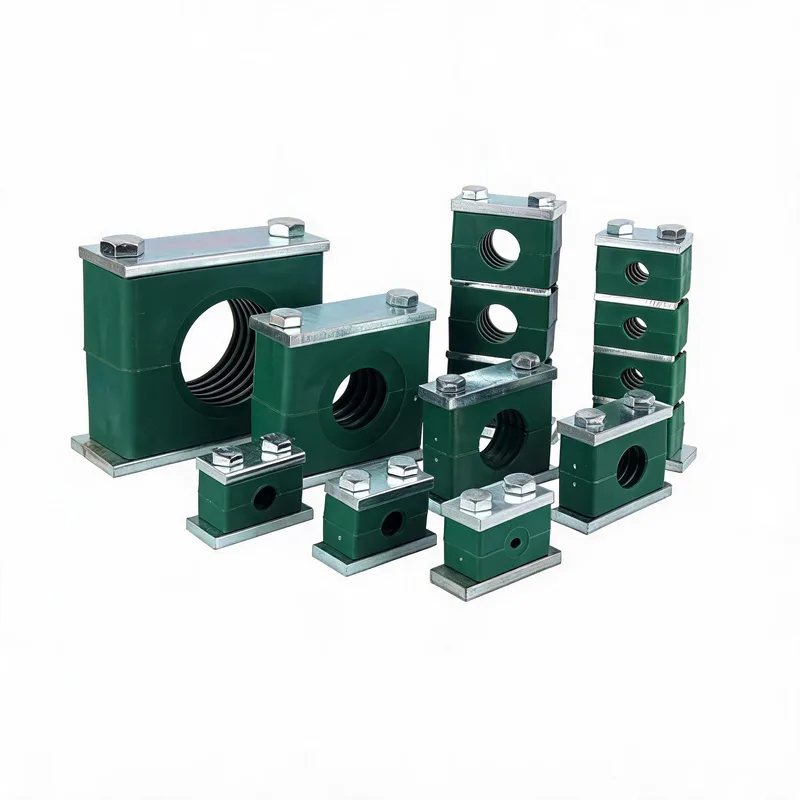
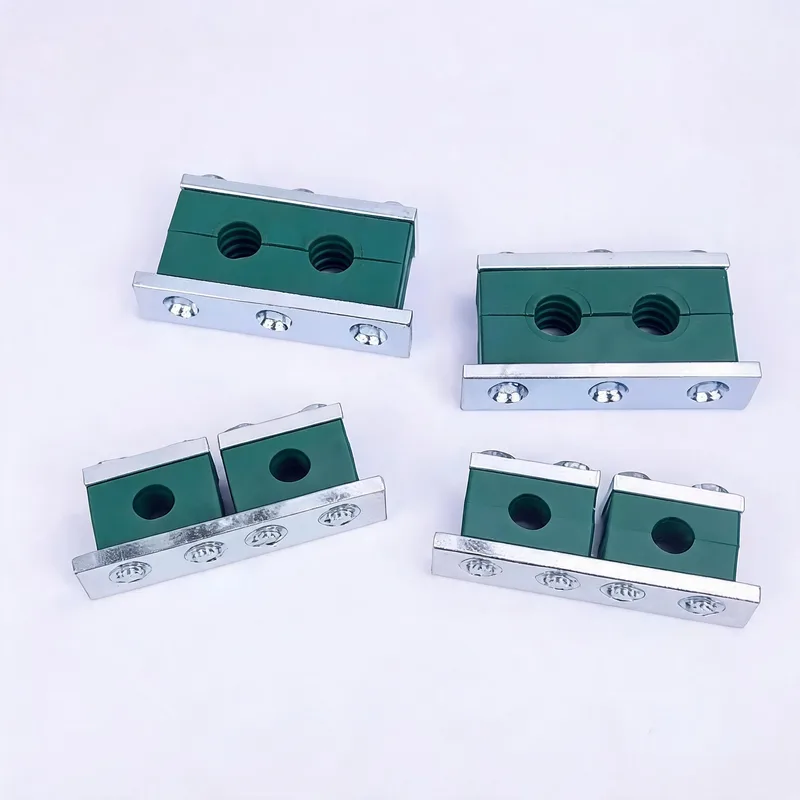
Key points
- Transverse vibration (perpendicular to bolt axis) loosens bolts far faster than axial vibration — this is the critical variable in pump and compressor installations where the dominant motion is lateral.
- M8 bolts torqued to 20 Nm typically lose 15–25% of preload in the first 24 hours on vibrating equipment — a re-torque within 48 hours of commissioning is the single most effective prevention step.
- Grade 10.9 bolts maintain preload longer than Grade 8.8 under cyclic loading: higher yield strength means more elastic elongation per unit torque, giving greater preload reserve against microslip.
- Thread-locking compound Loctite 243 (medium-strength, serviceable) is the preferred solution for DIN 3015 M8–M12 fasteners in general industrial vibration below 150 °C — apply to clean, dry threads and allow 24 h cure before loading.
- Visual inspection cannot detect Phase 1 loosening — only a torque audit (re-applying the specified torque and checking for movement) reveals whether preload has dropped on a visually tight fastener.
Bolt securing methods: effectiveness under transverse vibration
| Method | Vibration resistance | Best for |
|---|---|---|
| Standard hex nut (DIN 934) | ★☆☆☆ None | Static loads only |
| Spring / split washer | ★☆☆☆ Negligible | Not recommended for vibration |
| Nylon-insert prevailing torque nut (DIN 985) | ★★★☆ Good | General vibration ≤120 °C |
| All-metal prevailing torque nut (DIN 982) | ★★★☆ Good | High-temp vibration ≤300 °C |
| Thread-locking compound (e.g. Loctite 243) | ★★★★ Very good | Permanent or serviceable ≤150 °C |
| Nord-Lock wedge washer pair | ★★★★ Very good | High vibration, reusable joint |
Spring (split) washers are not recommended — research confirms negligible benefit under transverse vibration as bolt elongation absorbs the washer spring force.
The Junker mechanism: why transverse vibration is the dominant cause
The foundational model for bolt loosening under vibration was established by Gerhard Junker and has since been validated across thousands of fastener configurations in peer-reviewed research. The mechanism is as follows: when a bolted joint is subjected to transverse shear loads, the clamped surfaces experience cyclic microslip at their interfaces. Each cycle of microslip moves the nut slightly in the loosening direction, because thread geometry converts lateral motion into rotational motion at the thread-nut interface. Over many cycles, this accumulates into measurable preload loss — and eventually into full loosening with visible nut rotation. The critical insight is that loosening is not caused by vibration acting directly on the nut; it is caused by relative motion at the joint interface being transmitted through the thread to rotate the nut. This is why a torque wrench alone cannot prevent loosening on vibrating equipment: no matter how well a standard nut is tightened, transverse vibration will eventually cause it to loosen if no additional retention mechanism is present. For DIN 3015 pipe clamps on rotating equipment, the joint interface is between the clamp body halves and between the clamp and the support rail — both are potential sources of the microslip that drives loosening.
Phase 1 vs Phase 2: catching loosening before it becomes failure
Research distinguishes two phases of vibration loosening with different implications for maintenance strategy. Phase 1 is preload reduction without nut rotation: microslip at the thread contact and the bearing surface under the nut dissipates energy and allows the bolt to partially relax. No rotation occurs — the bolt appears visually tight — but the clamping force may have dropped by 15–30% in the first 24 hours of service. This phase is reversible: re-torquing after initial bedding-in restores the intended preload, and a retention method prevents Phase 2 from following. Phase 2 begins when preload has fallen far enough for full-slip to occur at the thread interface. The nut rotates — sometimes imperceptibly at first, then accelerating — until the bolt is loose or falls out entirely. Phase 2 is the dangerous condition, and the transition from Phase 1 to Phase 2 can happen quickly once full-slip begins. The practical implication is that an inspection schedule limited to visual checks will not catch Phase 1 loosening. A torque audit — re-applying the specified torque to each fastener and noting whether it moves — is the correct method for detecting Phase 1 before it progresses to failure.
Re-torque intervals for vibrating service
The re-torque schedule for pipe clamp fasteners on vibrating equipment follows from the physics of preload relaxation and the risk level of the installation. The most critical re-torque is always the first one, applied 24–48 hours after initial installation: this compensates for Phase 1 bedding-in losses and is the single most effective maintenance action against loosening. After the first re-torque, a 3-month interval is appropriate for general industrial service; reduce to 1 month for high-vibration applications — compressors, diesel engines, reciprocating pumps — or any installation where vibration amplitude exceeds 0.5 mm. Where a thread-locking compound or prevailing torque nut is used, the maintenance interval may be extended, but an annual torque audit remains advisable. For safety-critical lines — high-pressure steam, hydrogen, process gas — the re-torque schedule should be a documented mandatory maintenance procedure rather than an advisory. Torque values for DIN 3015 WQL-series clamp fasteners are published on the torque reference page; apply 80% of nominal torque on first tightening and 100% at first re-torque to account for initial embedding losses.
What to write in the RFQ for vibration-critical installations
A pipe clamp ordered without vibration-specific requirements will be supplied with standard DIN 934 hex nuts, which provide no protection against loosening. Buyers purchasing for vibrating service should add four items to their RFQ. First: describe the vibration environment — "installation on [pump / compressor / diesel engine], vibration frequency approx. [Hz], amplitude approx. [mm]" — so the supplier can confirm the correct fastener type. Second: specify bolt grade — Grade 10.9 is recommended over 8.8 for sustained vibration duty. Third: specify the nut type — "prevailing torque nut per DIN 985 (nylon insert, ≤120 °C) or DIN 982 (all-metal, ≤300 °C)" rather than accepting the standard hex nut default. Fourth: request the torque specification sheet — the correct Nm value per bolt size, and whether the value changes when thread-locking compound is used (it does: Loctite-treated joints are torqued to approximately 75% of the dry torque value because the lubricant reduces friction). WeiQue provides all four items of information with every order for vibration-rated installations.
Frequently asked questions
Why do pipe clamp bolts loosen on vibrating equipment even when correctly torqued?
The Junker mechanism: transverse vibration causes cyclic microslip at the thread and bearing surfaces, which accumulates into preload loss over time — without any visible nut rotation in the early phase. A standard torque wrench sets the initial preload but cannot prevent the microslip that follows. Prevailing torque nuts or thread-locking compound are required to resist this progressive loosening.
Are spring (split) washers effective at preventing bolt loosening under vibration?
No. Research confirms that spring washers provide negligible resistance to vibration-induced loosening. The bolt shank stretches elastically under torque, absorbing the washer spring force entirely — so the washer adds no meaningful clamping retention once the joint is loaded. Prevailing torque nuts (DIN 985 or DIN 982) or thread-locking compounds are the correct solutions.
What is the correct re-torque interval for pipe clamps on compressors and pumps?
The critical re-torque is always the first one: 24–48 hours after commissioning, to compensate for Phase 1 preload bedding-in losses. After that, 1-month intervals for high-vibration equipment (compressors, reciprocating pumps, diesel engines). For general industrial service with lower vibration, 3-month intervals are appropriate. Where Loctite or prevailing torque nuts are used, these intervals can be extended but an annual torque audit is still recommended.
Related WeiQue series


Recommended reading
References
Further reading: open-access research on vibration-induced bolt loosening, the Junker transverse vibration model, and fastener retention effectiveness
- Effect of Clamped Member Material and Thickness on Bolt Self-Loosening Under Transverse Loads — Materials 18(2):462 (MDPI, open access)
- Prediction of Self-Loosening Mechanism and Behavior of Bolted Joints on Automotive Chassis Using Artificial Intelligence — Machines 11(9):895 (MDPI, open access)
- Loosening of Bolted Connections under Transverse Loading in Timber Structures — Forests 11(8):816 (MDPI, open access)